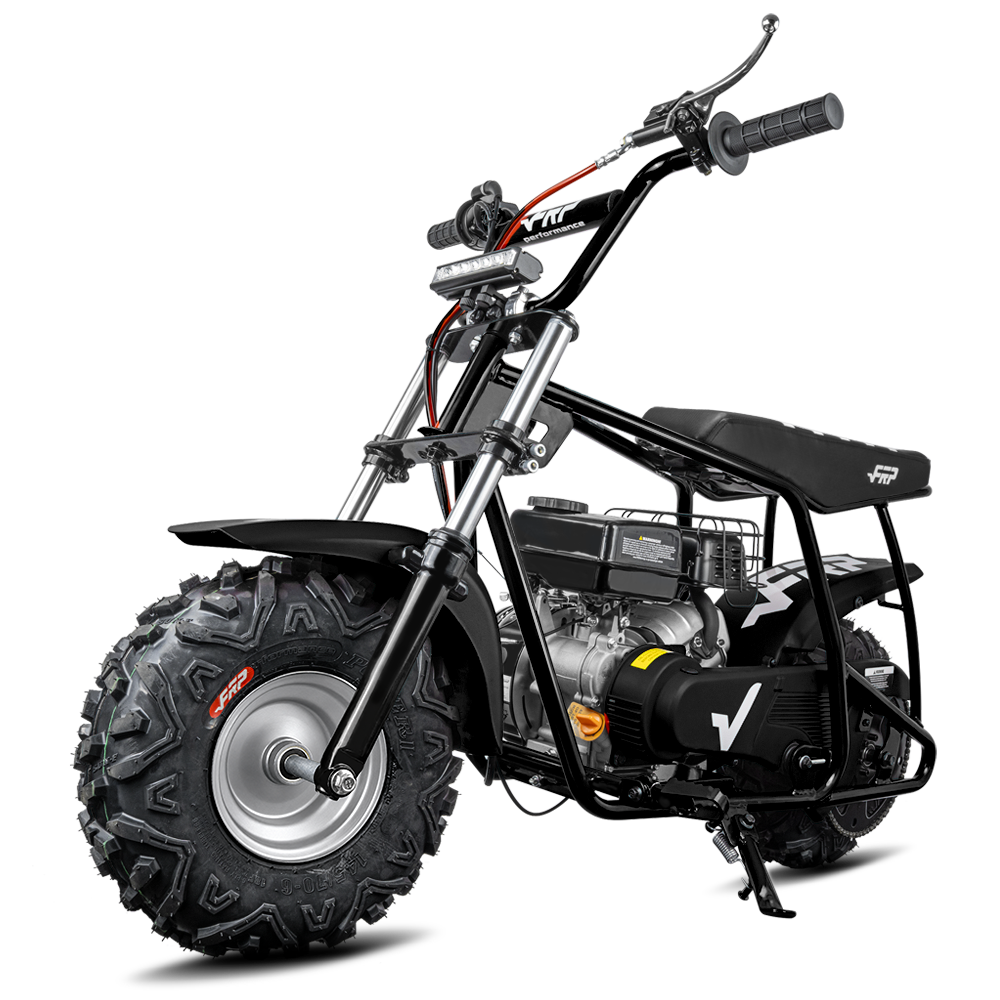

Two-stroke or four-stroke is the first real decision in buying a gas dirt bike or mini bike, and it decides more than engine noise. It sets how the bike makes power, what goes in the tank, what the maintenance calendar looks like, and which bikes are even on your shortlist. This guide covers the differences that change the ride, then gets specific about the three 4-stroke bikes FRP builds: the GMB100, FX125 and FX140.
2-Stroke vs 4-Stroke: The Differences That Change the Ride
A 2-stroke fires every time the piston comes up. A 4-stroke fires every other time. That one fact explains most of what follows.
Power delivery
A 2-stroke of a given size makes more peak power than a 4-stroke of the same size, and it makes it in a narrow band near the top of the rev range. Below that band it is soft, inside it the bike leaps. Riders call it the hit. A 4-stroke spreads its power across the whole rev range: less peak, more everywhere. You can short-shift it, lug it up a climb, or roll on from idle without the engine falling off the pipe.
Fuel and oil
A 2-stroke lubricates the crank with oil carried in the fuel. On most small dirt bikes and mini bikes that means premixing gas and oil at a set ratio before every fill. Some larger 2-strokes carry an oil-injection system that meters it for you, so premix is the common case, not a law. A 4-stroke keeps its oil in the crankcase like a car. Straight pump gas in the tank, oil changed on a schedule. Our 2-stroke oil mix calculator covers the ratios if you already own a premix bike.
Maintenance
Neither engine is maintenance-free, and "4-strokes need less work" is only half true. A 2-stroke has fewer parts and a top-end rebuild is cheap and quick, but it comes around more often, and the fuel mix adds a step to every ride. A 4-stroke goes longer between rebuilds and asks only for oil changes and valve checks in between, but when a rebuild does come it involves the valvetrain and costs more. Which is "less" depends on hours ridden and whether you turn your own wrenches.
Weight and handling
Fewer parts means a 2-stroke engine weighs less, and on a full-size race bike that shows. On mini bikes and small-displacement trail bikes the gap narrows to a few pounds, and frame, wheels and tires matter more than the engine type.
Noise, emissions and where you can ride
A 2-stroke is louder, smokier and burns more fuel per hour. That is why nearly every small gas bike sold in the US today is a 4-stroke with EPA certification, and why some riding areas and youth programs allow only 4-strokes.
Which Is Better for Beginners?
Usually a 4-stroke, but not because it is slower. Because its power arrives in proportion to how far you twist the throttle. A new rider can roll on gently, feel the bike respond, and learn clutch, brakes and balance without an engine that waits and then jumps. The 2-stroke hit is exactly what experienced riders love about them, and exactly what tips a beginner off the back.
Two exceptions. A rider coming from a motocross background, or a kid moving up from a 2-stroke 50 they have already mastered, may prefer the lighter, snappier 2-stroke. And if the local scene is 2-stroke racing, learning on what you will race makes sense.
For everyone starting from zero, a 4-stroke with manageable displacement is the right first bike. Below 100cc with an automatic clutch if the goal is backyard laps and a first taste of throttle. Around 125cc with a manual clutch if the goal is learning to ride a real motorcycle.
Which Bikes Don't Need Mixed Gas?
Every FRP gas bike currently in the lineup is a 4-stroke. None of them take premix. Fill with 87-octane or higher pump gas, check the oil on the dipstick, ride.
- GMB100: 99cc 4-stroke OHV. Oil lives in the crankcase. First change after the 2-3 hour break-in, then every 20-25 riding hours. Full schedule in the mini bike oil guide.
- FX125: 125cc air-cooled 4-stroke with a wet multi-plate clutch. Engine oil and clutch share the sump, so use a motorcycle-rated oil, not car oil with friction modifiers.
- FX140: 140cc oil-cooled 4-stroke. Same wet-clutch rule. The oil cooler adds capacity and holds temperature on long climbs, which is the point of the bigger engine.
If you own a 2-stroke and are tired of measuring oil at the pump, that is a fair reason to look at the list above. If you love your 2-stroke, keep it and use the ratio chart.
Which FRP 4-Stroke Bike Should You Choose?
Three bikes, three jobs. Pick by how you ride, not by the biggest number.
| GMB100 | FX125 | FX140 | |
|---|---|---|---|
| Engine | 99cc 4-stroke OHV, air-cooled | 125cc 4-stroke, air-cooled | 140cc 4-stroke, oil-cooled |
| Transmission | Automatic centrifugal clutch | 4-speed manual, wet clutch | 4-speed manual, wet clutch |
| Start | Pull start | Electric + kick | Electric + kick |
| Top speed | About 28 mph | About 56 mph | About 65 mph |
| Rider load | 220 lb | 265 lb | 265 lb |
| Seat height | Mini bike, low | 28.1" (14/12 wheels) or 33.9" (17/14) | 33.9" |
| Brakes | Disc | Hydraulic disc front and rear | Hydraulic disc front and rear |
| Who it is for | First gas bike, backyard and easy trail, no clutch to learn | Learning to shift, teens and adults, trail and pit | Experienced riders, long sessions, hot days, steep climbs |
| See the GMB100 | See the FX125 | See the FX140 |
GMB100 is the no-clutch entry. Twist and go, 28 mph on flat ground, a frame that takes a Predator 212 later if you outgrow the 99cc. It is a private-property and trail bike, not a commuter.
FX125 is the first real motorcycle. A true 4-speed with a clutch lever, electric start, and two wheel sizes so a 5'2" rider and a 6'0" rider can both get flat-footed. Our 14/12 vs 17/14 guide explains the choice.
FX140 shares the FX125's chassis, seat and wheelbase, and swaps in the oil-cooled 140. More power is the obvious part. Holding that power through an hour-long session on a hot day without fading is the reason to pay for it.
All three share FRP's parts supply: engines, clutches, brake kits and wear items stocked in the US and listed in FRP replacement parts.
FAQ
Do FRP bikes need mixed gas?
No. Every current FRP gas bike is a 4-stroke. Straight pump gas, 87 octane or higher, with oil in the crankcase.
Is a 4-stroke always less maintenance than a 2-stroke?
No. A 4-stroke goes longer between rebuilds and skips the fuel-mixing step, but its rebuild is bigger when it comes, and it needs oil changes and valve checks on schedule. Hours ridden decide which costs more.
Can a complete beginner start on a manual-clutch 4-stroke like the FX125?
Yes, and many do. The 4-stroke's gradual power makes stalling and clutch work forgiving. If the rider is under about 5'4" or wants zero learning curve, start on the GMB100 instead.
Why does a 2-stroke 50 feel faster than a 4-stroke 99?
Peak power. A 2-stroke makes roughly twice the power strokes per revolution, so it out-punches a 4-stroke of similar size at full revs. The 4-stroke wins everywhere below that, which is where most riding happens.
What oil do the FX125 and FX140 take?
A motorcycle-rated 4-stroke oil, because the engine and wet clutch share it. Car oil with friction modifiers can make the clutch slip. Weight and change intervals are in each bike's user manual on its product page.
Are these bikes street legal?
No. All FRP bikes are built for off-road use on private property, trails and designated riding areas.