
TL;DR
A monkey bike is a small-wheel, compact motorcycle style that traces back to Honda's Z-series mini motorcycles. Today, the clearest modern example is the Honda Monkey 125, a street-oriented 124cc motorcycle with 12-inch wheels, a five-speed manual transmission, and a 30.5-inch seat height.
But people searching for a "monkey bike" are not always looking for an actual Honda Monkey.
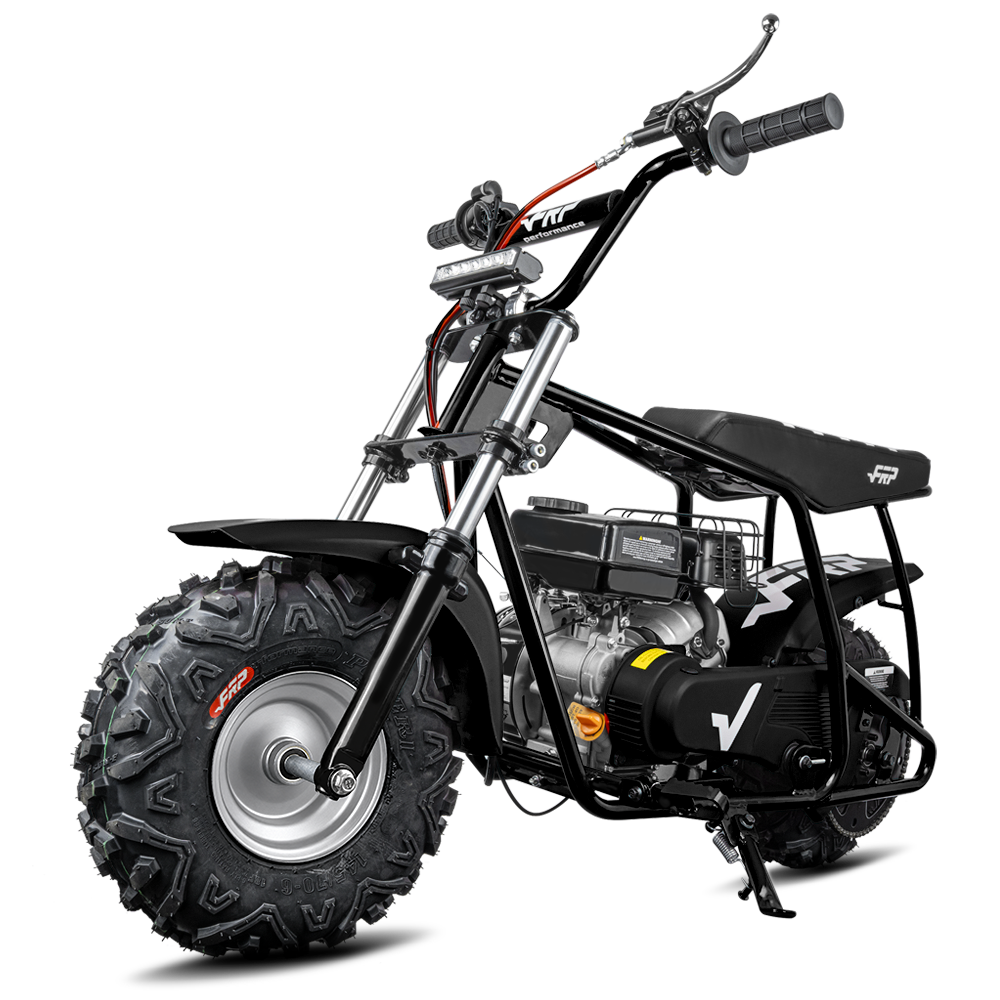
Some want a small, easy gas bike for a yard or trail, like an FRP gas mini bike. Others want a small manual motorcycle for learning clutch and shifting skills. Those riders may be better served by an off-road mini bike or pit bike instead.
Here's the simple version:
| If you want... | Look at... |
|---|---|
| A real street-going Monkey | Honda Monkey 125 |
| Simple gas-powered off-road fun with no shifting | FRP GMB100 mini bike |
| A small off-road motorcycle with a manual clutch | FRP FX125 pit bike |
| An extremely small sportbike-style machine | Pocket bike |
They're related by size and riding appeal, but they are not the same type of bike.
What Is a Monkey Bike?
Originally, "Monkey" referred to Honda's tiny Z-series motorcycles.
Honda built the first Monkey Z100 in 1961 as an amusement-park ride at Tama Tech in Japan. Its tiny frame and wheels made it radically smaller than a normal motorcycle, yet both children and adults could ride it.
That basic idea eventually evolved into the Honda Monkey motorcycles riders recognize today: compact dimensions, small wheels, an upright riding position, a relatively low seat, and full motorcycle controls packed into a deliberately small chassis.
The current Honda Monkey 125 keeps that formula alive with:
-
124cc air-cooled four-stroke engine
-
Five-speed manual transmission
-
12-inch wheels
-
30.5-inch seat height
-
Front-wheel ABS
-
231 lb curb weight
You'll also hear riders use "monkey bike" more loosely for motorcycles that resemble the classic Honda formula.
That's useful shorthand, but there's an important distinction:
A Honda Monkey is a specific motorcycle. A mini bike or pit bike may deliver some of the same small-bike fun without actually being a Monkey.
That distinction matters when you're deciding what to buy.
Monkey Bike vs Mini Bike vs Pit Bike vs Pocket Bike
These categories overlap visually, which is where most of the confusion starts.
| Monkey Bike | Gas Mini Bike |
Pit Bike |
Pocket Bike | |
| Typical example | Honda Monkey 125 | FRP GMB100 | FRP FX125 | Mini sportbike |
| Main use | Street / casual riding | Yard, trails, private land | Dirt, trails, track | Pavement / closed course |
| Transmission | Manual | Usually automatic clutch | Usually manual | Often automatic |
| Riding position | Upright | Relaxed, compact | Dirt-bike stance | Very low and cramped |
| Wheels | Small road wheels | Wide mini-bike tires | Dirt-bike wheels | Extremely small road tires |
| Suspension | Motorcycle-style | Varies by model | Longer-travel dirt suspension | Minimal |
| Street use | Designed for road use | Generally off-road | Generally off-road | Generally not road legal |
| Best for | Small road-bike experience | Easy recreational riding | Learning dirt-bike skills | Novelty / small-track riding |

The biggest difference isn't engine size.
It's what the bike is designed to do.
A Honda Monkey is still a real street motorcycle despite its small size.
A gas mini bike prioritizes simplicity and recreational riding.
A pit bike is much closer to a scaled-down dirt bike.
And a pocket bike puts the rider extremely low on a miniature sportbike chassis.
So don't choose based on the words "small motorcycle" alone.
Choose based on where you'll ride and how involved you want the controls to be.
What Does a Monkey Bike Feel Like to Ride?
The appeal of a monkey bike is not simply that it has a small engine.
It's the way the entire bike feels.
Compared with a full-size motorcycle, a small-wheel bike generally feels:
-
compact underneath you
-
easy to maneuver at low speed
-
quick to respond to steering inputs
-
easy to park and store
-
less physically intimidating for a new rider
That compactness is also part of the compromise.
Small wheels react more noticeably to potholes, bumps, and rough surfaces than larger motorcycle wheels. The cockpit can also feel tight for taller riders, especially on longer rides.
That's why monkey bikes are often most fun for:
-
short recreational rides
-
urban riding
-
casual weekend use
-
riders who value agility over high-speed stability
-
experienced motorcyclists who simply enjoy small bikes
The fact that an adult looks slightly oversized on one isn't a defect.
That's part of the appeal.
Can Adults Ride a Monkey Bike?
Absolutely.
In fact, the modern Honda Monkey is designed around adult riders.
But "Can I physically ride it?" and "Will I be comfortable on it?" are different questions.
For adults, look at four things.
1. Seat height
The current Honda Monkey has a 30.5-inch seat height.
That's relatively approachable, but whether you can comfortably get your feet down depends on your inseam rather than height alone.
2. Legroom
Taller riders can ride small motorcycles, but the distance between the seat and foot controls may feel compact.
For a 20-minute fun ride, that may be part of the charm.
For a two-hour ride, it may matter much more.
3. Rider weight
With an off-road mini bike, check the manufacturer's actual load rating rather than assuming that a physically small bike is only for kids.
For example, the FRP GMB100 is rated for riders up to 220 lb.
4. Intended use
A 6-foot adult cruising around town and a 6-foot adult riding across a rough field have completely different needs.
The first rider may prefer a Monkey.
The second may be better served by a mini bike with wide off-road tires or a pit bike with more ground clearance and suspension travel.
Are Monkey Bikes Street Legal?
Some are. Some aren't.
This is one of the most important distinctions in the category.
Honda Monkey 125
The Honda Monkey 125 is built as a road motorcycle, with equipment including lighting, hydraulic disc brakes, ABS, mirrors, and other road-bike hardware.
You'll still need to follow the registration, insurance, licensing, and helmet requirements where you live.
Gas Mini Bikes
A recreational gas mini bike such as the FRP GMB100 should not be assumed to be street legal.
It's sold for off-road recreational use.
Depending on where you live, there may also be specific rules for OHVs, trails, public land, neighborhood streets, or private property.

Pit Bikes
Pit bikes such as the FRP FX140 are also designed around off-road riding rather than normal public-road use.
If your actual goal is commuting on public streets, start with a road-legal motorcycle.
If your goal is riding around a yard, trail, campsite, farm, or permitted off-road area, a recreational mini bike may make more sense.
How Fast Do Monkey Bikes Go?
There's no single "monkey bike speed" because the category now covers very different machines.
Engine size alone doesn't determine speed. Gearing, wheel diameter, rider weight, terrain, aerodynamics, and transmission all matter.
For comparison:
| Bike | Engine | Transmission | Intended Use |
| Honda Monkey 125 | 124cc | 5-speed manual | Street |
| FRP GMB100 | 99cc-class | Automatic clutch | Recreational off-road |
| FRP FX125 | 125cc | 4-speed manual | Off-road / pit bike |
The current GMB100 is rated up to 24 mph in stock form.
The FX125 is a much more performance-oriented dirt/pit bike and is rated by FRP at approximately 56 mph, depending on conditions and configuration.
Honda does not publish a single official top-speed figure for the Monkey 125.
More importantly, don't choose between these bikes based on top speed alone.
A 24 mph mini bike and a 125cc manual pit bike are intended to give very different riding experiences.
Is a Monkey Bike Good for Beginners?
It can be, but "small" doesn't automatically mean "beginner-friendly."
A beginner has to manage several things at once:
-
balance
-
throttle
-
braking
-
steering
-
clutch
-
gears
-
terrain
-
traffic
The fewer new controls you introduce at once, the easier the first learning sessions usually are.
That's where the three bike types separate.
Want to learn real motorcycle controls?
The Honda Monkey gives you a manual clutch and five-speed transmission in a compact chassis.
That can make it an approachable way to learn traditional motorcycle operation, but you're still learning clutch control, shifting, braking, and road awareness.
Don't want to learn shifting yet?
An automatic-clutch mini bike removes clutch and gear changes from the equation.
The FRP GMB100 uses a 99cc-class four-stroke engine, pull start, and automatic clutch, so the rider can focus more on throttle, braking, steering, and balance.
Shop the GMB100 99cc Gas Mini Bike →
Want to learn dirt-bike skills?
Then a pit bike makes more sense.
The FRP FX125 uses a true four-speed manual transmission with a wet multi-plate clutch, plus dirt-bike suspension, hydraulic disc brakes, and either a 14"/12" or 17"/14" wheel setup.
That makes it a much more relevant choice for riders whose goal is learning manual off-road riding rather than simply cruising around.
Shop the FX125 125cc Pit Bike →
Honda Monkey vs FRP GMB100: Which One Is Actually Right for You?
These bikes shouldn't be treated as direct substitutes.
They solve different problems.
Choose the Honda Monkey if:
-
You want to ride on public roads.
-
You want a true Honda Monkey.
-
You like retro motorcycle styling.
-
You want a manual transmission.
-
You expect to ride in urban or paved environments.
-
Street registration and motorcycle ownership are part of the experience you want.
The 2026 Monkey starts at a Honda base MSRP of roughly $4,399, before destination charges, taxes, registration, insurance, and other costs.
Choose a GMB100 if:
-
You're riding off-road or on permitted private property.
-
You want a simple gas-powered recreational machine.
-
You don't want to operate a manual clutch.
-
You want a bike light enough to move around relatively easily.
-
You're buying a first gas mini bike.
-
You care more about backyard or trail fun than road transportation.
The GMB100 weighs about 79.5 lb, uses a pull-start 99cc-class four-stroke, has a rear disc brake, wide 145/70-6 off-road tires, and carries riders up to 220 lb.
That's a very different machine from the 231 lb Honda Monkey.
And that's exactly why some shoppers may prefer it.
Browse FRP Gas Mini Bikes →
Monkey Bike vs Pit Bike: Which Should You Buy?
This is an even easier distinction.
Buy a Monkey-style road bike if you want a small motorcycle.
Buy a pit bike if you want a small dirt bike.
A pit bike generally gives you:
-
more ground clearance
-
larger wheels
-
longer suspension travel
-
a dirt-bike riding position
-
aggressive off-road tires
-
more ability on rough terrain
For example, the FX125 is available with either:
-
14"/12" wheels and a lower 28.1-inch seat height, or
-
17"/14" wheels and a taller 33.9-inch seat height
Both use a 125cc four-stroke engine and four-speed manual clutch.
If what attracted you to the phrase "monkey bike" was simply the idea of a small gas motorcycle with real gears, a pit bike may actually be closer to what you're looking for.
What About a Pocket Bike?
A pocket bike is smaller again.
Think miniature sportbike rather than miniature standard motorcycle.
Pocket bikes typically put the rider very low, with tiny wheels and a much tighter riding position.
That's different from both:
-
the upright, retro character of a Monkey, and
-
the relaxed seating of an American-style mini bike.
If you're still figuring out the terminology, read our pocket bike explainer before buying. A photo can make all four categories look "small," but they feel very different once you're sitting on them.
How Much Does a Monkey Bike Cost?
The answer depends heavily on what you mean by "monkey bike."
New Honda Monkey
The 2026 Honda Monkey has a base MSRP of approximately $4,399.
Remember that a road motorcycle may also involve destination charges, dealer fees, registration, insurance, riding gear, and licensing costs.
Vintage Honda Monkey / Z-series bikes
There's no single useful price.
Condition, originality, model year, restoration quality, title status, and rarity can change the value dramatically.
A cheap vintage bike can also become an expensive project once you start replacing old fuel-system, electrical, brake, tire, or engine components.
Gas mini bike
A recreational mini bike can cost far less than a street motorcycle because you're buying a much simpler machine for a different use case.
The GMB100, for example, currently starts well below the cost of a new Honda Monkey.
Don't interpret that price difference as one being a "cheap Monkey."
They're fundamentally different vehicles.
Who Should Buy a Monkey Bike?
A real Monkey-style motorcycle makes a lot of sense if you:
-
want something small and easy to maneuver
-
enjoy retro motorcycles
-
mainly take shorter recreational rides
-
don't need a large touring motorcycle
-
want full motorcycle controls in a compact package
-
simply enjoy the character of riding a tiny bike
It may not be your best choice if you:
-
regularly ride at sustained highway speeds
-
need lots of passenger or cargo capacity
-
want maximum long-distance comfort
-
spend most of your time on rough trails
-
need full-size dirt-bike suspension and ground clearance
And if you only want an easy gas-powered machine for recreational off-road riding, buying a street motorcycle may be solving a problem you don't actually have.
That's where a mini bike becomes worth considering.
What Should You Check Before Buying a Small Gas Bike?
Before choosing a Monkey, mini bike, pit bike, or pocket bike, answer these questions first.
Where will I ride?
Public road, backyard, trail, track, farm, campground, or private property?
This question can eliminate half your options immediately.
Do I want to shift gears?
If yes, look at a Monkey or manual pit bike.
If no, an automatic-clutch mini bike is much simpler.
How rough is the terrain?
Smooth pavement and packed dirt do not require the same wheels, suspension, or ground clearance as roots, rocks, ruts, or jumps.
Will the bike fit me?
Check:
-
seat height
-
rider weight rating
-
handlebar position
-
footpeg location
-
wheelbase
-
overall size
Don't shop by engine displacement alone.
Can I get replacement parts?
Small gas bikes get ridden, dropped, modified, and maintained.
Before buying one, check whether you can actually get:
-
brake parts
-
chains
-
sprockets
-
tires
-
throttle components
-
pull-start parts
-
controls
-
engine parts
Parts availability matters much more after six months than it does on checkout day.
Can You Build a Monkey-Style Mini Bike Yourself?
If the part you love most is the simplicity, modifying or building a mini bike can be as appealing as buying a finished one.
American-style mini bikes have a large DIY culture built around:
-
engine swaps
-
gearing changes
-
frames
-
brakes
-
tires
-
handlebars
-
seats
-
controls
The GMB100 frame, for example, is commonly used as a starting point for custom builds, including experienced-builder projects involving larger engines such as the Predator 212.
An engine swap is not simply an engine swap, though.
Changing engine output can also affect:
-
clutch compatibility
-
chain alignment
-
gearing
-
braking requirements
-
frame loads
-
throttle setup
-
safe operating speed
If you're planning one, read our Predator 212 mini bike build guide before buying parts.

A Short History of the Honda Monkey
The story starts in Japan in 1961.
Honda created the Monkey Z100 for its Tama Tech amusement park. It used a 50cc four-stroke engine and tiny 5-inch tires.
Honda quickly realized that the little machine had appeal beyond an amusement park.
Export versions followed, and by the late 1960s the Z50 had reached markets including the United States.
Later Z50 models moved to larger 8-inch wheels and became the small, instantly recognizable motorcycles many riders now associate with the classic Monkey shape.
The original 50cc Monkey family lasted for decades.
Honda revived the concept in modern form with the Monkey 125 in 2018, preserving the small-wheel proportions and playful styling while giving it modern brakes, suspension, fuel injection, lighting, and eventually a five-speed gearbox.
That's why the Monkey has survived.
Not because small motorcycles are supposed to be practical.
Because small motorcycles can be ridiculously fun.
So, What Is a Monkey Bike Today?
The most accurate answer is:
A monkey bike is a compact, small-wheel motorcycle style rooted in Honda's Monkey/Z-series motorcycles.
The Honda Monkey 125 is the modern direct continuation of that idea.
A gas mini bike like the FRP GMB100 isn't a Honda Monkey and shouldn't be confused with one. But it may be the better choice for someone whose real goal is simple, low-cost, automatic-clutch recreational riding off-road.
Likewise, a pit bike such as the FX125 isn't a Monkey either. It's the better path if what you actually want is a small manual off-road motorcycle that teaches clutch and shifting skills.
So don't start by asking:
"Which monkey bike should I buy?"
Start with:
"Where do I want to ride, and how do I want the bike to work?"
Once you answer that, the category usually chooses itself.
FAQ
Why is it called a monkey bike?
The name is associated with Honda's early Monkey series, which began with the tiny Z100 amusement-park machine in 1961. The unusual proportions of an adult riding such a small motorcycle helped give the Monkey its playful identity.
Is a monkey bike the same as a mini bike?
No.
The terms overlap in casual conversation, but they come from different traditions.
"Monkey" is closely associated with Honda's Z-series small motorcycles. "Mini bike" is a broader term, especially in the U.S., for compact recreational motorized bikes, often with automatic clutches and wide tires.
Is a monkey bike the same as a pit bike?
No.
A pit bike is based more closely on dirt-bike design, with off-road suspension, a dirt-bike riding position, larger wheels, and often a manual clutch.
Are monkey bikes street legal?
A Honda Monkey 125 is built as a road motorcycle and can be registered for road use subject to local laws.
Recreational mini bikes and pit bikes should not automatically be assumed road legal. Check the rules where you live.
Can adults ride monkey bikes?
Yes.
Modern Monkey motorcycles are built for adult riders. Adult fit still depends on inseam, legroom, body size, and how long you plan to ride.
For off-road mini bikes, also check the manufacturer's load rating. The FRP GMB100, for example, is rated for riders up to 220 lb.
Is a monkey bike good for a beginner?
It can be.
A small chassis can feel less intimidating than a full-size motorcycle, but a manual Monkey still requires clutch and gear control.
If a first-time rider wants to avoid shifting entirely, an automatic-clutch mini bike may provide a simpler introduction to gas-powered riding.
Should I buy a Honda Monkey or a gas mini bike?
Buy the Honda Monkey if you want a small street motorcycle with a manual transmission.
Choose a gas mini bike if your main use is recreational off-road riding and you value simple controls and lower cost over road capability.
Where can I buy a monkey bike?
Honda dealers sell the current Monkey 125.
For recreational off-road alternatives, FRP offers gas mini bikes such as the GMB100 and manual pit bikes such as the FX125.
Explore: Gas Mini Bikes · GMB100 99cc Mini Bike · FX125 125cc Pit Bike · Pocket Bike Guide