
Published: August 20, 2026
TL;DR
The Z50M, Z50A and Z50J are three major steps in the classic Honda Monkey story, but the easiest way to tell them apart is not simply "hardtail versus rear shocks."
The 1967 Z50M is the tiny early Monkey with 5-inch wheels. The Z50A moved to 8-inch wheels and became the Mini Trail familiar to American riders, with early US versions using a rigid rear and later versions gaining rear suspension. The Z50J, introduced in Japan in 1974, also used 8-inch wheels and rear suspension, but belonged to a different market lineage and introduced the frame architecture that shaped later Japanese Monkeys.
If you're identifying a bike today, check these in order:
- Wheel size
- Frame and rear suspension
- Tank, fenders and other model-year details
- Frame serial number
- Original market
Rear shocks alone are not enough to call a bike a Z50J.
Direct Answer: Z50M vs Z50A vs Z50J
All three belong to Honda's classic small-wheel Monkey family and share the basic idea that made the bike famous: a compact frame, small wheels and Honda's horizontal 49cc four-stroke single.
But they are not simply three trim levels of the same bike.
The Z50M represents the earliest road-going Japanese Monkey formula.
The Z50A enlarged the wheels from 5 to 8 inches and became especially important in the United States as the Mini Trail 50.
The Z50J arrived in Japan in 1974 with front and rear suspension and a redesigned frame that Honda continued developing for decades.
One important US-market detail: later American Z50As also had rear suspension. That means an 8-inch Honda with twin rear shocks is not automatically a Z50J.
Z50M vs Z50A vs Z50J at a Glance
| Z50M | Z50A / Mini Trail | Z50J | |
|---|---|---|---|
| Introduced | 1967 | 1968 US / 1969 Japan | 1974 Japan |
| Main identity | Early road-going Monkey | Mini Trail / second-generation Monkey | Later Japanese Monkey generation |
| Wheels | 5-inch | 8-inch | 8-inch |
| Early rear suspension | Rigid | Early US models rigid | Front and rear suspension |
| Later rear suspension | — | US Z50A gained rear suspension from the K3 era | Rear suspension remained part of the design |
| Engine layout | 49cc horizontal four-stroke single | 49cc horizontal four-stroke single | 49cc horizontal four-stroke single |
| Easy visual clue | Extremely small wheels and compact proportions | 8-inch wheels, Mini Trail styling and US-market details | Japanese-market model identity, suspended frame and later Monkey styling |
| Best confirmation | Serial + model details | K-series / serial + market | Model code / serial + market |
Illustrative timeline of the classic 49cc Monkey lineage. The 1985 update to a 4-speed manual falls between the 1978 and 2017 milestones.
The most important takeaway is that wheel size can narrow the generation quickly, but suspension alone cannot reliably separate a later Z50A from a Z50J.
What Year Is My Honda Z50?
If you have an unknown Z50 in front of you, don't start by guessing from the paint.
Use this order instead.
1. Check the wheel size
The original Z50M used 5-inch wheels, giving it noticeably smaller proportions than the models that followed.
Honda moved to 8-inch wheels with the Z50A, and that size continued through the classic Z50A and Z50J family.
So:
5-inch wheels → strong Z50M-era clue
8-inch wheels → move on to the next checks
2. Look at the rear of the frame
An early US Z50A with a rigid rear is easy to recognize and is often referred to by collectors as a hardtail.
But Honda later added rear suspension to the American Mini Trail.
That matters because one of the most common identification shortcuts online is:
Hardtail = Z50A
Twin shocks = Z50J
That shortcut is incomplete.
A later US-market Z50A can also have twin rear shocks.
3. Identify the market
Market is one of the strongest clues.
The Z50A became the familiar Mini Trail in the United States. Honda continued developing the Z50A line for the US market through the 1970s before the Z50R took over the small off-road role.
The Z50J was introduced in Japan in 1974 and belongs to the Japanese and other non-US Monkey lineage.
That is why genuine Z50Js found in the United States are generally imported bikes rather than normal US-market Mini Trails.
4. Check the tank, fenders, seat and controls
These details become especially useful once you've narrowed down the basic family.
Honda changed:
- Tank graphics
- Fuel tank shape
- Fender finish
- Seat design
- Hand controls
- Lighting
- Side covers
- Exhaust details
across different revisions.
One important example is the famous teardrop fuel tank. It became part of the Monkey's long-running visual identity with the 1978 redesign — it is not a universal identifying feature of every Z50J from 1974 onward.
5. Check the frame serial number
For serious identification, the frame number matters more than paint.
Paint, seats, tanks and fenders can all be replaced during a restoration. Many surviving Z50s now use reproduction parts or parts taken from another year.
The frame number lets you compare the bike against known year and model ranges.
If you're evaluating a collectible example, also compare the engine number. An original or period-correct combination is generally more interesting to collectors than a bike assembled from unrelated parts.
Z50A vs Z50J: Why People Confuse Them
This is where the family tree gets interesting.
The Z50J was not created in isolation.
Honda developed the 1974 Japanese Z50J using the 1972 American MINI TRAIL 50 Z50AK3 as its base.
That explains why later Z50As and early Z50Js can look much more closely related than the simple "A versus J" model names suggest.
The Z50J introduced a newly designed frame that became especially important to the Monkey's future. Honda continued building on that basic direction for decades.
So when identifying one today, think less like this:
Does it have rear shocks?
And more like this:
Which market was this built for, which frame generation is it, and which serial range does it belong to?
The Engine That Made the Monkey Bigger Than the Monkey
The Z50 story matters beyond collectors because of what happened to its engine layout.
Honda's compact horizontal four-stroke single became one of the most recognizable small-motorcycle engine layouts ever built.
Early Z50M and Z50A models paired the 49cc engine with a simple semi-automatic transmission, helping make the bikes approachable for new riders.
The Monkey continued evolving. Later versions gained additional gearing, and by the mid-1980s Honda had moved the Japanese Monkey to a 4-speed manual transmission.
But the basic horizontal-engine concept spread far beyond the original Z50.
Versions of that layout appeared across Honda's small motorcycles and were later widely copied and developed by other manufacturers. Today, similar horizontal-single layouts are common in 110cc and 125cc pit bikes.
That is why a modern 125cc pit bike can look mechanically familiar to someone who grew up working on Honda's small horizontal-engine motorcycles.
The displacement changed.
The performance changed.
The original idea never really disappeared.
Want the modern 125cc version of that small-bike formula?
The FRP FX125 takes the idea in a modern pit-bike direction with a 125cc platform designed for riders who want to ride rather than restore a vintage Honda.
 Shop the FX125 125cc Pit Bike →
What Happened After the Z50J?
The Z50J was an important turning point, but it should not be treated as one completely unchanged model that ran from 1974 to 2017.
Honda continued revising the Monkey.
In 1978, the bike adopted the teardrop-shaped fuel tank and larger seat that would define its appearance for years.
Later changes included updates to the engine, transmission, emissions equipment and eventually fuel injection.
Honda kept the 49cc Monkey lineage alive until 2017, when it marked the end of the small-displacement era with a 50th Anniversary model.
The next chapter arrived with the larger Monkey 125.
So when someone says "the Z50 ran until 2017," the more accurate way to think about it is:
The classic 49cc Monkey family kept evolving until 2017.
Not:
The exact 1974 Z50J remained unchanged for 43 years.
Should You Buy a Vintage Z50 Today?
That depends on what you're actually trying to get from the bike.
There are really three different buyers.
1. You want the collectible
Then look for an original Z50M, early Z50A Mini Trail or another historically interesting example.
In that case, originality matters.
You will care about:
- Correct frame and engine numbers
- Original tank and paint
- Correct fenders
- Correct seat
- Period controls
- Factory hardware
- Reproduction versus OEM parts
For this buyer, restoration and research are part of the experience.
2. You want a modern Honda Monkey
Then the Monkey 125 is Honda's own modern answer.
It keeps the compact proportions and visual nostalgia of the old Monkey while being a completely modern motorcycle.
This is the route for someone who wants the Honda badge and Monkey heritage without maintaining a 40- or 50-year-old machine.
3. You mostly want a small gas bike that's fun to ride
This is a different buyer — and probably a much larger one.
Maybe what attracted you to the Z50 was never the serial number.
Maybe it was simply that the bike is:
- Small
- Easy to store
- Mechanically simple
- Fun at low speeds
- Easy to work on
- Less intimidating than a full-size motorcycle
If that's what you actually want, buying and restoring a collectible Honda may be solving the wrong problem.
A modern mini bike gives you the small-bike experience without asking you to become a vintage-Honda restorer first.
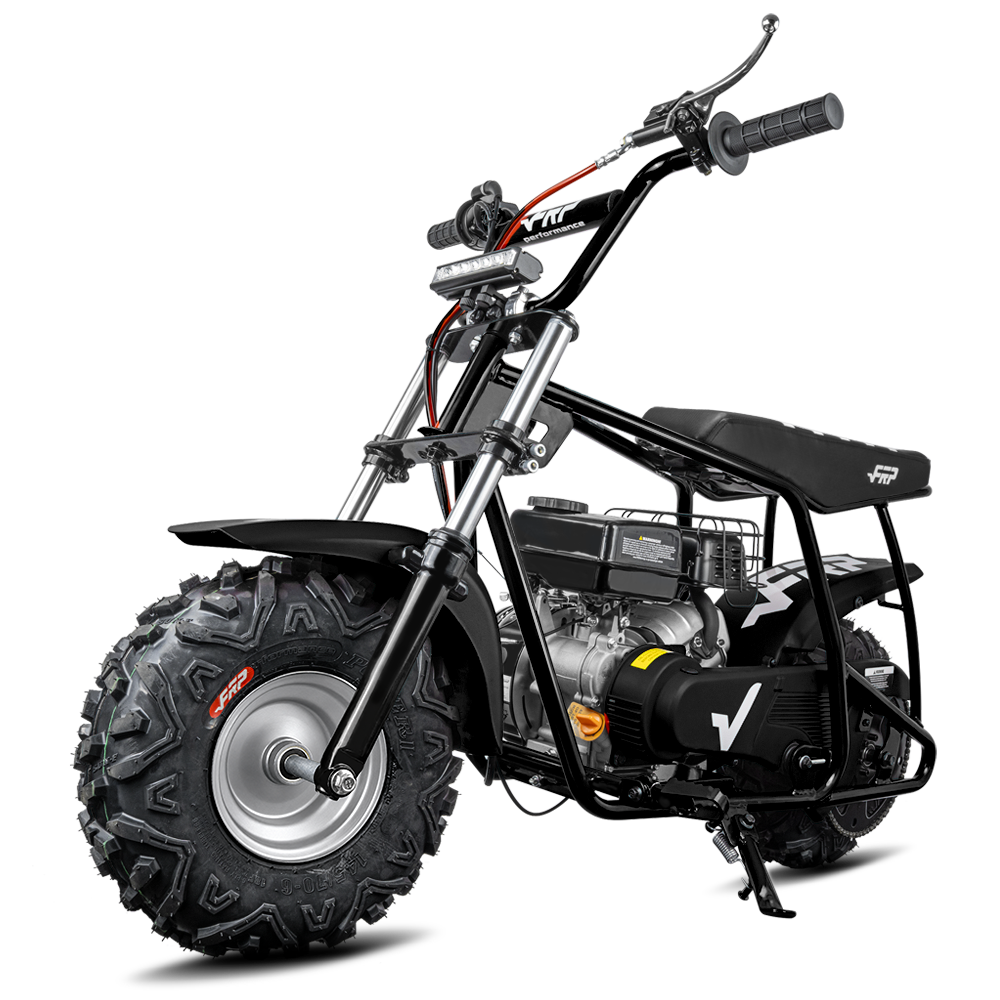
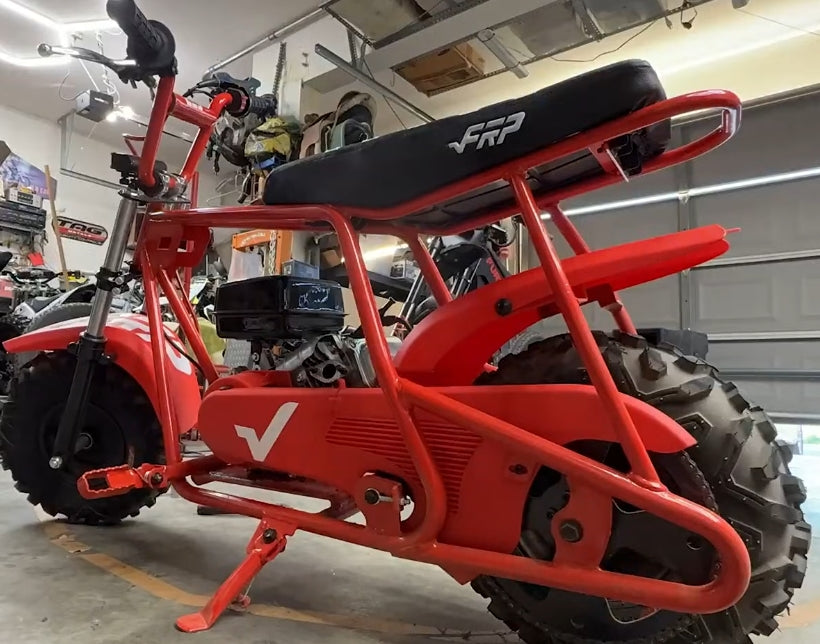
The FRP GMB100 uses a 99cc four-stroke engine, has a claimed top speed of up to 24 mph and supports riders up to 220 lb.
It is not a Z50 replica, and it does not need to be.
It serves the rider who looks at an old Monkey and thinks:
I want something small and simple like that — but I want to ride it now.

Vintage Z50 or Modern Mini Bike?
| If you care most about... | Better route |
|---|---|
| Honda history | Vintage Z50 |
| Collectibility | Original Z50M / Z50A / Z50J |
| Restoring old motorcycles | Vintage Z50 |
| Honda's modern Monkey styling | Monkey 125 |
| Simple recreational riding | Modern mini bike |
| A modern 125cc pit-bike platform | FRP FX125 |
| Compact gas-powered fun without vintage restoration | FRP GMB100 |
There is no wrong answer here.
The question is whether you want to own the history or simply enjoy the idea that made the Monkey famous in the first place.
Why the Monkey Formula Still Works
The original Z50 was successful because Honda did not try to make a normal motorcycle slightly smaller.
It made something that was intentionally tiny.
That changed the experience.
A small bike could fit where a conventional motorcycle could not. It felt approachable. It invited people to ride it casually. It was mechanically simple enough to understand.
That idea is still relevant.
Today's mini bikes and pit bikes are faster, larger and built for different kinds of riding, but the basic attraction is surprisingly similar:
small machine, simple controls, big amount of fun.
That is why people are still searching for Monkey bikes decades after the first Z50M appeared.
FAQ
What is the difference between a Z50M, Z50A and Z50J?
The Z50M is the early 1967-era Monkey identified most easily by its tiny 5-inch wheels. The Z50A moved to 8-inch wheels and became the Mini Trail familiar to American riders. The Z50J arrived in Japan in 1974 with front and rear suspension and a redesigned frame that influenced later Monkey generations.
What is the difference between a Z50A and Z50J?
Market and model history matter more than rear shocks alone. The US continued receiving Z50A Mini Trails, including later versions with rear suspension, while Honda introduced the Z50J in Japan in 1974. Check the frame number and market-specific details rather than identifying one from suspension alone.
Does rear suspension mean I have a Z50J?
No. Later US-market Z50As also used rear suspension. Twin rear shocks therefore do not automatically identify a bike as a Z50J.
What year is my Honda Z50?
Start with wheel size, frame design and market-specific details, then confirm the bike using its frame serial number. Do not rely only on paint or body parts because many surviving Z50s have been restored or fitted with reproduction components.
Did the Z50A have rear suspension?
Early versions did not. Later US Z50A Mini Trails gained rear suspension, which is one reason they are sometimes confused with Z50Js.
What engine did the Honda Z50 use?
The classic Z50 family used Honda's air-cooled horizontal 49cc four-stroke single. Transmission specifications changed across the Monkey's long production history, so not every later 49cc Monkey used the same 3-speed semi-automatic setup as the earliest bikes.
When did the Monkey get the teardrop fuel tank?
Honda introduced the familiar teardrop-shaped tank as part of the 1978 Monkey redesign.
Was the Z50J sold in the United States?
The Z50J belongs primarily to the Japanese and other non-US Monkey lineage. American buyers received the Z50A Mini Trail through the 1970s before Honda moved to models such as the Z50R. Z50Js found in the US today are therefore commonly imports.
Do they still make the Honda Z50?
No. Honda ended the classic 49cc Monkey lineage in 2017. The modern Honda Monkey uses a larger 125cc-class platform.
Is a vintage Z50 better than a modern mini bike?
They solve different problems. Buy the Z50 if Honda history, originality and restoration are part of what you want. Choose a modern mini bike if the part you love is simply having a compact, approachable gas-powered bike you can ride without maintaining a collectible motorcycle.
Keep Exploring
- What Is a Monkey Bike? → Understand where the name came from and what actually counts as a Monkey bike.
- Can You Still Buy a Monkey Bike? → Compare vintage Monkeys, Honda's Monkey 125 and modern alternatives.
- 50cc vs 125cc → See what changes when you move from the original small-engine formula to a modern 125cc platform.
- Can You Build Your Own Monkey Bike? → See what a frame-first DIY build actually requires.
Shop FRP Gas Mini Bikes · FX125 125cc Pit Bike · GMB100 99cc Mini Bike