
TL;DR
For many first-time adult riders, a lightweight 125cc manual dirt bike is easier to learn on than a full-size 250cc bike.
The hardest part of learning is usually not managing horsepower. It is coordinating the clutch, throttle, gears, brakes, and balance at the same time. A lighter, lower bike reduces the physical workload while teaching the same fundamental manual-riding skills.
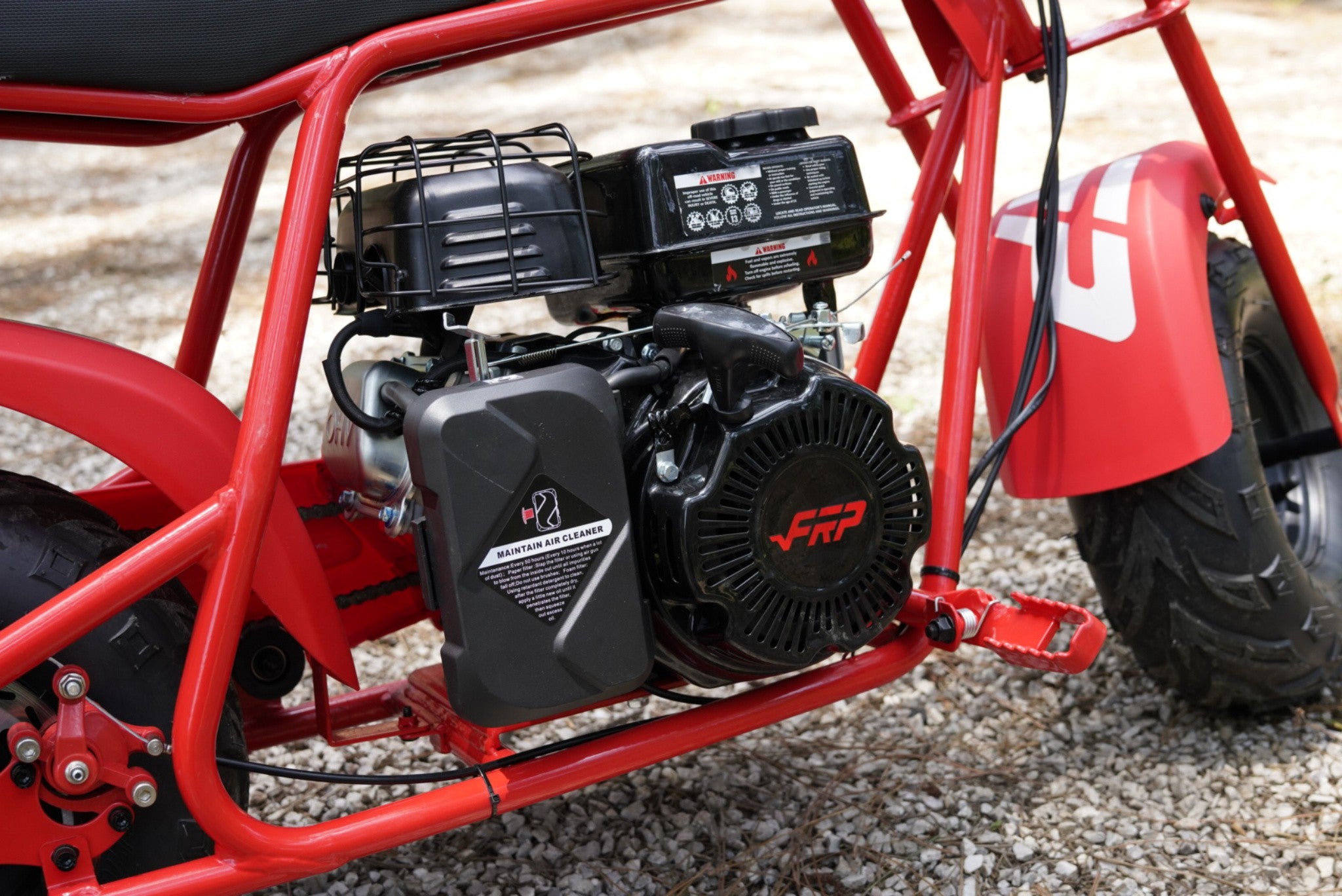
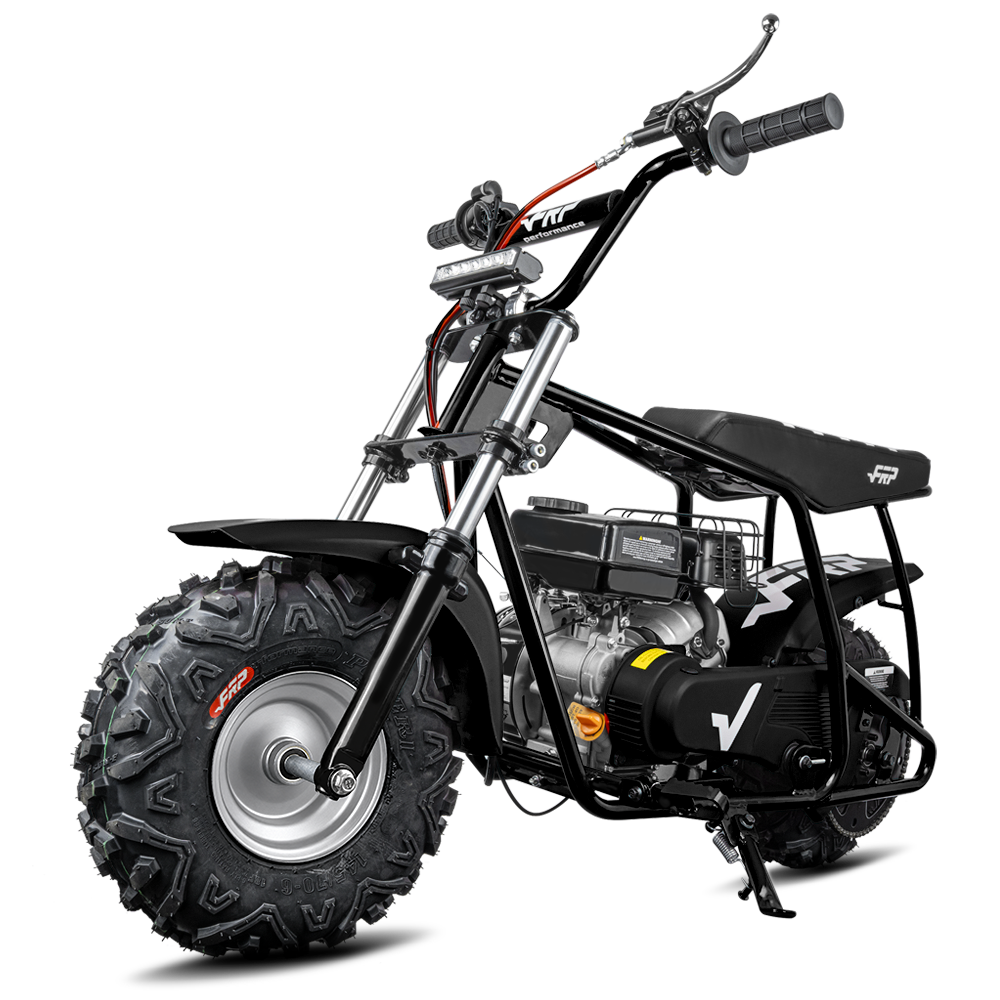
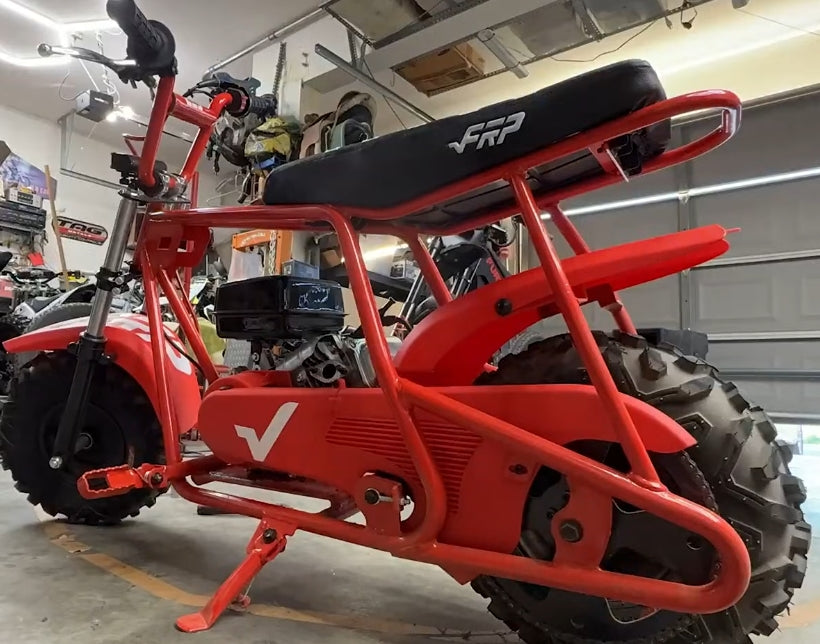
The FRP FX125 is a 125cc four-stroke dirt bike with a four-speed manual transmission, a wet multi-plate clutch, an 8.7 hp rated output, a maximum rider capacity of 265 lb, two wheel and seat-height configurations, and a starting price of $799.99.
Choose the 14"/12" small-wheel FX125 if lower seat height and easier handling are your priorities. Choose the 17"/14" big-wheel FX125 if you are taller or want more ground clearance.
A 250cc trail bike may still be the better choice for a taller, heavier, or more experienced adult who expects to ride faster or tackle more demanding terrain. The correct first bike depends on rider fit and intended use—not engine size alone.
Riders who do not want to learn a clutch yet can consider the automatic FRP GMB100 mini bike. Riders who already understand manual controls and specifically want stronger acceleration can compare the FX125 with the FRP FX140.
Important: The FX125, FX140, and GMB100 are off-road vehicles intended for private property and permitted riding areas. They are not street-legal motorcycles.

What Is the Best Beginner Dirt Bike for an Adult?
For many adult beginners, the best first dirt bike is a lightweight four-stroke with manageable power, a seat height that fits, and controls that match the skills they want to learn.
That does not automatically mean every beginner should buy a 125cc bike. It also does not mean every adult needs to start on a 250cc.
The right choice depends on rider height and inseam, equipped rider weight, previous motorcycle experience, physical strength, riding terrain, desired speed, and whether the rider wants a manual clutch.
A rider who is completely new to motorcycles may learn faster on a lighter platform because less attention is required to hold up, maneuver, and recover the bike. A taller rider with prior clutch experience and access to open trails may be comfortable starting on a larger bike.
The goal is not to select the smallest or largest engine. It is to choose a bike that lets the rider practice consistently without being physically overwhelmed.
Why a 125cc Manual Can Make Sense for Adult Beginners
A manual 125cc dirt bike can teach the same foundational control skills used on larger motorcycles: clutch engagement, gear selection, throttle coordination, front and rear braking, low-speed balance, standing body position, hill starts, and terrain awareness.
The main advantage is not that a 125cc bike is automatically safer or better. The advantage is that a lightweight 125cc platform can reduce the amount of weight, height, and power a new rider must manage while learning those skills.
Lower weight
The FX125 small-wheel configuration weighs approximately 150 lb. A lighter bike is generally easier to push around a garage or yard, balance at walking speed, turn in tight areas, recover when it begins to lean, pick up after a tip-over, and load and transport. For a beginner, these practical handling tasks often matter more than maximum engine output.
Lower seat-height option
The FX125 is available with a 28.1-inch seat height in its 14"/12" configuration. That gives shorter adults and cautious beginners an option that is substantially lower than many full-size dirt bikes. A lower seat can improve confidence during starts, stops, slow turns, stalls, uneven terrain, and first-gear practice.
Manageable power delivery
The FX125 uses a 125cc four-stroke engine. A four-stroke engine generally provides smoother and more predictable power delivery than a high-strung competition-oriented machine. That can make throttle control easier for a new rider.
Lower purchase cost
At $799.99, the FX125 requires less initial investment than many full-size adult dirt bikes. That can be relevant for riders who are still deciding whether off-road riding will become a long-term hobby. Lower price should not be the only buying factor, but it reduces the financial risk of purchasing a first bike.
Is a 250cc Dirt Bike Too Much for a Beginner?
Not always. A 250cc four-stroke trail bike can be an appropriate first bike for some adults, particularly riders who are taller, have a longer inseam, are physically comfortable handling a heavier machine, already understand manual clutch operation, have previous street-motorcycle experience, plan to ride open or demanding terrain, or want a bike they are less likely to outgrow quickly.
However, a full-size 250cc bike can be more difficult for a completely new rider if it is too tall, too heavy, too powerful for the available practice area, expensive to drop or damage, or physically difficult to recover after a stall.
The issue is not the "250cc" label by itself. Different 250cc models vary significantly in weight, power delivery, suspension, seat height, and intended use. A mild 250cc trail bike is different from a competition motocross bike. Adult beginners should compare the exact model rather than treating every 250cc dirt bike as the same category.
FX125 vs a Typical Full-Size 250cc Dirt Bike
| Feature | FRP FX125 | Full-size 250cc dirt bike |
|---|---|---|
| Engine | 125cc four-stroke | 250cc four-stroke |
| Transmission | Four-speed manual | Usually manual |
| Clutch | Wet multi-plate clutch | Usually wet clutch |
| Rated output | 8.7 hp | Varies significantly |
| Seat height | 28.1" or 33.9" | Varies by model; often taller |
| Weight | Approximately 150 lb or 170 lb | Usually heavier, depending on model |
| Maximum rider capacity | 265 lb | Varies by manufacturer |
| Price | $799.99 | Varies widely by brand and model |
| Best use | Learning, private property, recreational trails | Faster riding, more demanding terrain, experienced riders |
The comparison should not be interpreted as "125cc is better than 250cc." A more accurate conclusion is that a lightweight 125cc manual may be easier for many new adults to learn on, while a 250cc bike may suit riders whose size, experience, and terrain justify the additional performance.
The Hardest Part of Learning Is Coordination
New riders often focus on engine size, but the first challenge is usually coordinating several controls at once.
A manual start requires the rider to pull in the clutch, select first gear, apply a small amount of throttle, release the clutch gradually, maintain balance, keep the bike moving, and shift or stop safely.
Beginners commonly stall because they release the clutch too quickly or fail to add enough throttle. They may also lose balance because too much attention is focused on the controls.
A lighter bike does not remove the learning process. It reduces the physical effort required while the rider repeats it. That is the principal reason a lightweight manual dirt bike can be effective as a training platform.
Get the Seat Height Right Before Choosing More Power
Seat height directly affects confidence. A beginner should be able to stop the bike without feeling that it will immediately fall over. The rider does not always need to place both feet completely flat on the ground, but should be able to establish a stable footing.
FX125 14"/12" small-wheel build
This build has a 28.1-inch seat height, weighs approximately 150 lb, has a lower overall stance and easier ground reach, and is better suited to shorter adults and riders prioritizing low-speed confidence. It is the more approachable choice for many first-time riders.
For more sizing guidance, see best beginner dirt bikes for women and shorter adults.
FX125 17"/14" big-wheel build
This build has a 33.9-inch seat height, weighs approximately 170 lb, and offers more ground clearance, larger wheels, and a more conventional dirt-bike stance for taller adults. The larger wheels roll over ruts, roots, and uneven terrain more easily, but the increased seat height may be less comfortable for shorter riders.
Both FX125 configurations use the same engine and manual clutch. The decision is primarily about fit and terrain, not power. For a direct comparison, see the 14"/12" vs 17"/14" dirt bike wheel-size guide.
How to Check Whether a Dirt Bike Fits You
Before purchasing, evaluate more than total height. Inseam, leg length, arm length, and riding posture all affect fit.
A suitable beginner bike should allow you to reach the handlebars without locking your elbows, operate the clutch and front brake comfortably, reach the rear brake and shifter, place at least one foot firmly on the ground, stand on the pegs with slightly bent knees, move forward and backward on the seat, and hold the bike upright when it begins to lean.
A rider can be within the bike's weight limit and still feel cramped. A rider can also be tall enough for the bike but lack the confidence or strength to manage its weight. Fit must be evaluated as a complete system.
Is the FX125 Powerful Enough for an Adult?
For learning, private-property riding, and moderate recreational trails, the FX125 can provide enough power for many adults. It can be used to practice clutch engagement, gear changes, starting and stopping, low-speed riding, basic cornering, standing on the foot pegs, moderate trail riding, and basic hill technique.
The FX125 has a manufacturer-stated top speed of approximately 56 mph under suitable conditions. Actual speed depends on rider weight, terrain, elevation, wind, surface conditions, maintenance, engine condition, and gearing. Top speed should not be the main deciding factor for a beginner.
A 125cc bike may begin to feel limited when the rider wants stronger acceleration, more mid-range torque, higher sustained speeds, better performance on long climbs, faster riding across open terrain, or more advanced suspension performance. At that point, moving to a larger or more capable bike may be reasonable.
When a 125cc Dirt Bike May Not Be Enough
A 125cc manual is not the ideal first bike for every adult. Consider a larger or different platform when:
You are physically cramped
If your knees, arms, or standing position feel restricted even on the big-wheel configuration, the chassis may be too small.
You are close to the load limit
The FX125 is rated for a maximum rider load of 265 lb, which should include the rider's clothing and protective gear. A rider close to the maximum limit may experience reduced acceleration, increased suspension compression, longer braking distances, reduced hill-climbing performance, and less responsive handling.
You already have riding experience
A rider who already knows how to use a manual clutch may not need a low-power training platform.
Your terrain is primarily open and fast
A 125cc bike may feel limited if the intended use is sustained high-speed riding across large open areas.
You need more suspension capability
More demanding terrain may require larger wheels, more suspension travel, and a more robust chassis.
FX125 vs FX140 for Adult Riders
The FX140 is not automatically the better choice simply because it has a larger engine. It is better suited to riders who already understand basic manual controls and have a specific need for more performance.
| Feature | FX125 | FX140 |
|---|---|---|
| Engine | 125cc four-stroke | 140cc four-stroke |
| Cooling | Air cooled | Oil cooled |
| Rated output | 8.7 hp | 11 hp |
| Transmission | Four-speed manual | Manual |
| Maximum rider capacity | 265 lb | 265 lb |
| Manufacturer-stated top speed | Approximately 56 mph | Approximately 65 mph |
| Price | $799.99 | $1,449.99 |
| Best suited for | Learning and recreational riding | More experienced riders wanting stronger performance |
The FX140 provides more power, stronger acceleration, oil cooling, and a higher manufacturer-stated maximum speed. However, it has the same 265 lb maximum rider capacity as the FX125. It should not be presented as a higher-capacity bike for riders above the FX125's weight limit. A heavier rider may prefer the FX140's additional power, but still needs to remain within the same published load rating. Actual speed varies with rider weight, terrain, gearing, weather, and riding conditions.
For a detailed breakdown, see the FX125 vs FX140 comparison.

Manual Dirt Bike or Automatic Mini Bike?
Not every beginner wants to learn a clutch immediately. The better choice depends on which skills the rider wants to prioritize.
Choose a manual dirt bike when:
- You want to learn clutch control
- You want to practice shifting
- You plan to move to larger motorcycles
- You want transferable manual-riding skills
- You are willing to spend time practicing starts and stops
The FX125 is the manual option in this comparison.
Choose an automatic mini bike when:
- You want twist-and-go operation
- You want to focus on balance and braking first
- You do not want to manage a clutch
- You plan to ride mainly on private property
- You want a lower-cost introduction
The FRP GMB100 uses an automatic clutch and has a 99cc engine, a maximum speed of approximately 24 mph, a 220 lb maximum rider capacity, and a starting price of $399.99. The GMB100 is a mini bike, not a manual dirt bike. It can help a new rider practice throttle, braking, and balance, but it does not teach manual clutch engagement or gear shifting.
For a broader comparison, see manual vs automatic dirt bikes for beginners.
Which FRP Beginner Bike Should You Choose?
| Model | Vehicle type | Transmission | Maximum rider capacity | Best for | Price |
|---|---|---|---|---|---|
| GMB100 | 99cc mini bike | Automatic clutch | 220 lb | Riders who want simple twist-and-go operation | $399.99 |
| FX125 | 125cc dirt bike | Four-speed manual | 265 lb | Adults learning clutch and shifting | $799.99 |
| FX140 | 140cc dirt bike | Manual | 265 lb | Riders seeking stronger performance | $1,449.99 |
Choose the GMB100 if:
You do not want to use a clutch, you want the lowest-cost starting point, you are learning on private property, or you want to focus on balance first.
Choose the FX125 if:
You want a true manual dirt bike, you want to learn clutch and shifting, you need a lower seat-height option, you prefer a lighter training platform, or your main use is property riding or recreational trails.
Choose the FX140 if:
You already understand clutch control, you want stronger acceleration, you expect more open-terrain riding, you want oil cooling, or you have identified a specific performance limitation in the FX125 class.
The FX140 should be treated as a performance alternative, not a mandatory next step for every FX125 rider.
When Should You Move Up From a 125cc Dirt Bike?
Move up when your skill and riding conditions justify it. A rider may be ready for more performance when they can consistently start without repeated stalling, shift smoothly, use both brakes correctly, control the bike at low speed, ride while standing, recover from mistakes calmly, ride moderate trails without feeling overwhelmed, and identify a specific limitation in power, suspension, or chassis size.
Examples of genuine limitations include insufficient climbing performance, reaching maximum speed too easily, needing more suspension travel, riding mostly in open terrain, feeling physically cramped, or requiring a larger chassis.
Do not move up only because a larger engine appears more appropriate for an adult. Move up because the current bike no longer fits your body, skill level, or terrain.
Common Adult-Beginner Buying Mistakes
Choosing by engine displacement alone
Engine size does not reveal seat height, chassis size, weight, or power delivery.
Buying a bike that is too tall
A tall bike makes stops, stalls, and low-speed practice more difficult.
Ignoring equipped rider weight
Helmet, boots, body armor, and other equipment count toward the maximum rider capacity.
Assuming every 250cc bike is beginner-friendly
Trail, enduro, and motocross bikes can have very different power and handling characteristics.
Buying for future skill instead of current ability
A bike that fits now is generally easier to practice on than one purchased with the expectation of growing into it.
Choosing an automatic when the goal is to learn a clutch
An automatic bike teaches balance and throttle control, but not manual shifting.
Choosing a manual bike without planning practice time
Learning clutch control requires repetition in a safe, open area.
Prioritizing top speed
Beginners benefit more from predictable controls and correct fit than from a high maximum speed.
Ignoring riding-area restrictions
Off-road vehicles are not automatically legal on public roads, sidewalks, parks, or public trails.
Beginner Practice Plan
A new rider should not begin on steep, rocky, or crowded terrain. Start in a flat, open area with permission to ride.
Session 1: Controls and balance
Practice mounting and dismounting, identifying all controls, walking the bike with the engine off, using the brakes, and holding the bike upright.
Session 2: Clutch engagement
Practice finding the clutch friction zone, moving forward without throttle, stopping after a few feet, and repeating controlled starts.
Session 3: First gear
Practice smooth starts, straight-line riding, controlled stops, and looking ahead rather than down.
Session 4: Shifting
Practice shifting from first to second, downshifting before stopping, and coordinating throttle and clutch.
Session 5: Turns and body position
Practice wide turns, figure-eight patterns, standing on the pegs, and weight transfer.
Only progress to trails after basic control becomes consistent.
Beginner Safety Equipment
Adult beginners should wear proper off-road riding equipment from the first session. At minimum: a DOT-compliant off-road helmet, goggles or eye protection, riding gloves, over-the-ankle boots, long sleeves, durable pants, knee protection, and elbow protection.
Additional equipment may include a chest protector, neck protection, hip protection, and a riding jersey and pants. Do not treat low-speed practice as risk-free. Falls often occur during starts, stops, and slow turns.
FAQ
What is the best beginner dirt bike for an adult?
For many first-time adults, a lightweight 125cc four-stroke with a manual clutch is a practical starting point. The correct choice depends on rider fit, weight, prior experience, and terrain.
Is a 125cc or 250cc dirt bike better for an adult beginner?
A 125cc manual may be easier for a completely new rider because it is generally lighter and less intimidating. A 250cc trail bike may suit taller, stronger, or more experienced adults who plan to ride more demanding terrain. Neither engine size is automatically correct for every rider.
Is the FX125 a real manual dirt bike?
Yes. The FX125 uses a four-speed manual transmission and a wet multi-plate clutch.
Do I need to know how to use a clutch before buying the FX125?
No. The FX125 can be used to learn clutch and shifting. Beginners should practice in a flat, open area under appropriate supervision.
Can an adult ride a 125cc dirt bike?
Yes. The FX125 has a maximum rider capacity of 265 lb and is available with a 33.9-inch seat height in the big-wheel configuration. Adult suitability still depends on rider proportions and intended use.
Is the FX125 suitable for a 6-foot adult?
Possibly. A taller rider should evaluate the 17"/14" version with its 33.9-inch seat height. Fit also depends on inseam, arm length, and riding posture.
Can a heavier adult ride the FX125?
The FX125 is rated for a maximum rider load of 265 lb. Riding gear should be included in the total. Performance may decrease as rider weight approaches the maximum limit.
Is the FX140 better for heavier riders?
The FX140 provides more power and oil cooling, which may improve performance under load. However, it has the same 265 lb maximum rider capacity as the FX125. It does not provide additional load-rating margin.
Is a 125cc dirt bike powerful enough for trail riding?
It can be suitable for moderate recreational trails, depending on rider weight, terrain, and expected speed. It is not designed to provide the same performance as a larger competition or high-output trail bike.
How fast is the FX125?
The manufacturer-stated maximum speed is approximately 56 mph under suitable conditions. Actual speed varies with rider weight, terrain, gearing, weather, maintenance, and surface conditions.
Should a shorter adult choose the small-wheel FX125?
Usually, yes, when easier ground reach is the main priority. The small-wheel version has a 28.1-inch seat height compared with 33.9 inches on the big-wheel version.
What is the cheapest way for an adult to start riding?
The GMB100 costs $399.99 and uses an automatic clutch. It is the lowest-cost FRP option for learning throttle, braking, and balance, but it is a mini bike rather than a manual dirt bike.
Is an automatic mini bike easier than a manual dirt bike?
Yes, in terms of control complexity. An automatic mini bike removes clutch engagement and shifting, allowing the rider to focus on throttle, brakes, and balance.
Are the FX125, FX140, and GMB100 street legal?
No. They are intended for off-road use on private property and permitted riding areas. They are not street-legal motorcycles.
Are the FX125 and FX140 sold in California?
No. The FX125 and FX140 are not sold in California.
Final Recommendation
For many adults who want to learn on a true manual dirt bike, the FRP FX125 offers a balanced combination of a four-speed manual transmission, a wet clutch, manageable four-stroke power, two seat-height options, a maximum rider capacity of 265 lb, lower weight than many full-size dirt bikes, and a starting price of $799.99.
Choose the 14"/12" small-wheel FX125 when lower seat height and easier handling are the priorities. Choose the 17"/14" big-wheel FX125 when you are taller or need more ground clearance. Choose the GMB100 automatic mini bike if you want to learn throttle, braking, and balance without using a clutch. Consider the FX140 when you already understand manual controls and specifically want stronger acceleration, oil cooling, and higher-speed capability.
A 250cc trail bike may be appropriate when the rider is physically comfortable with a larger machine and expects to ride faster or tackle more demanding terrain.
The central buying rule is:
Choose the bike that fits your body, current skill level, and riding area. Add more engine only when your experience and terrain require it.