TL;DR
- No stock mini bike goes 70 mph — reaching 70 mph requires a purpose-built 212cc race engine with significant modifications.
- Stock speeds: 40–50cc = 18–25 mph · 99cc = 28 mph · 196cc = 30–35 mph · 212cc = 35–40 mph.
- A modified 212cc race build can reach 60–70+ mph, but requires performance cam, carb, exhaust, governor removal, and gearing changes.
- For private-property riding, 35–40 mph is the practical performance ceiling — fast enough to be fun, within reach of a real brake system.
- If 70 mph is the actual requirement, that's motorcycle territory — not a mini bike.
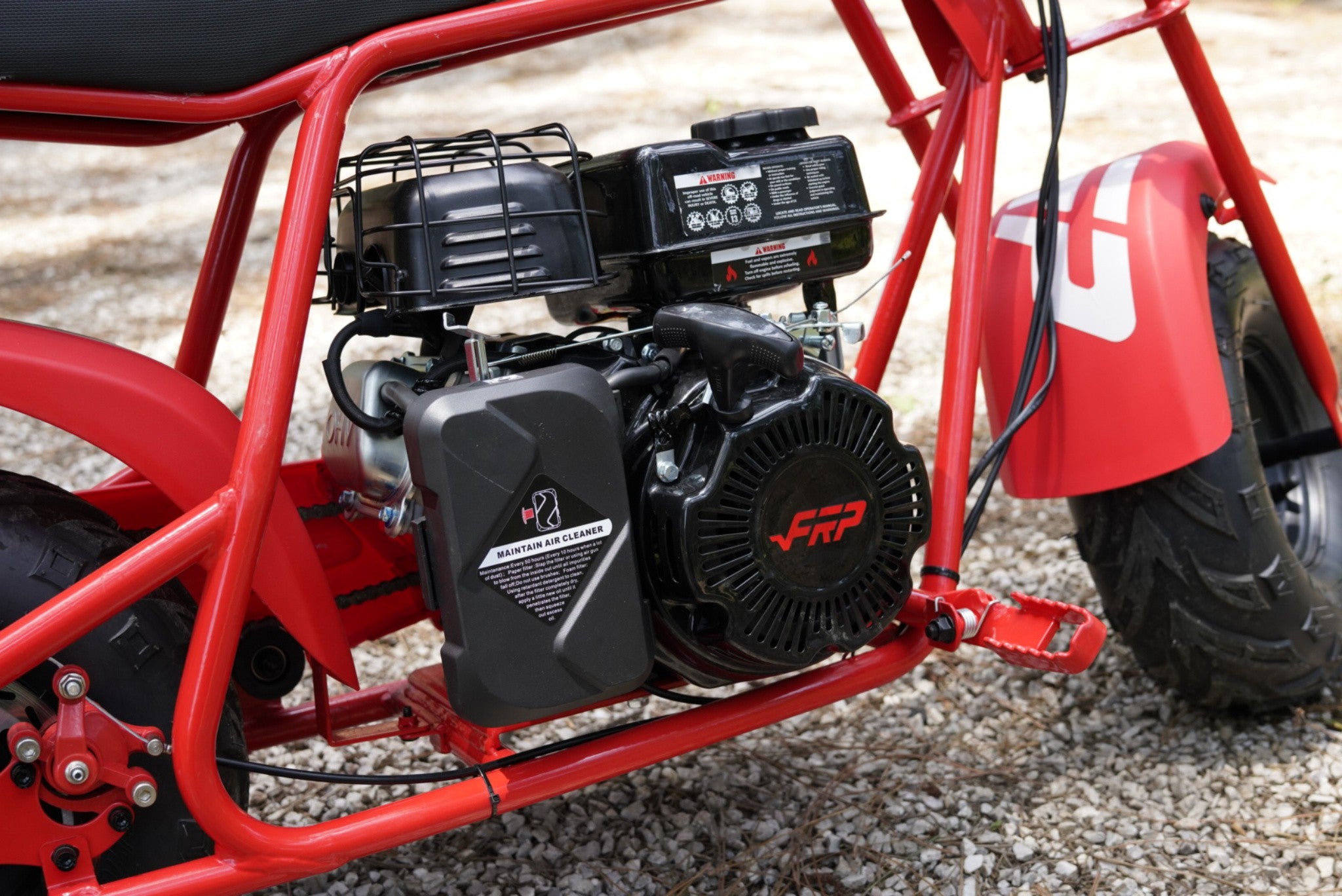
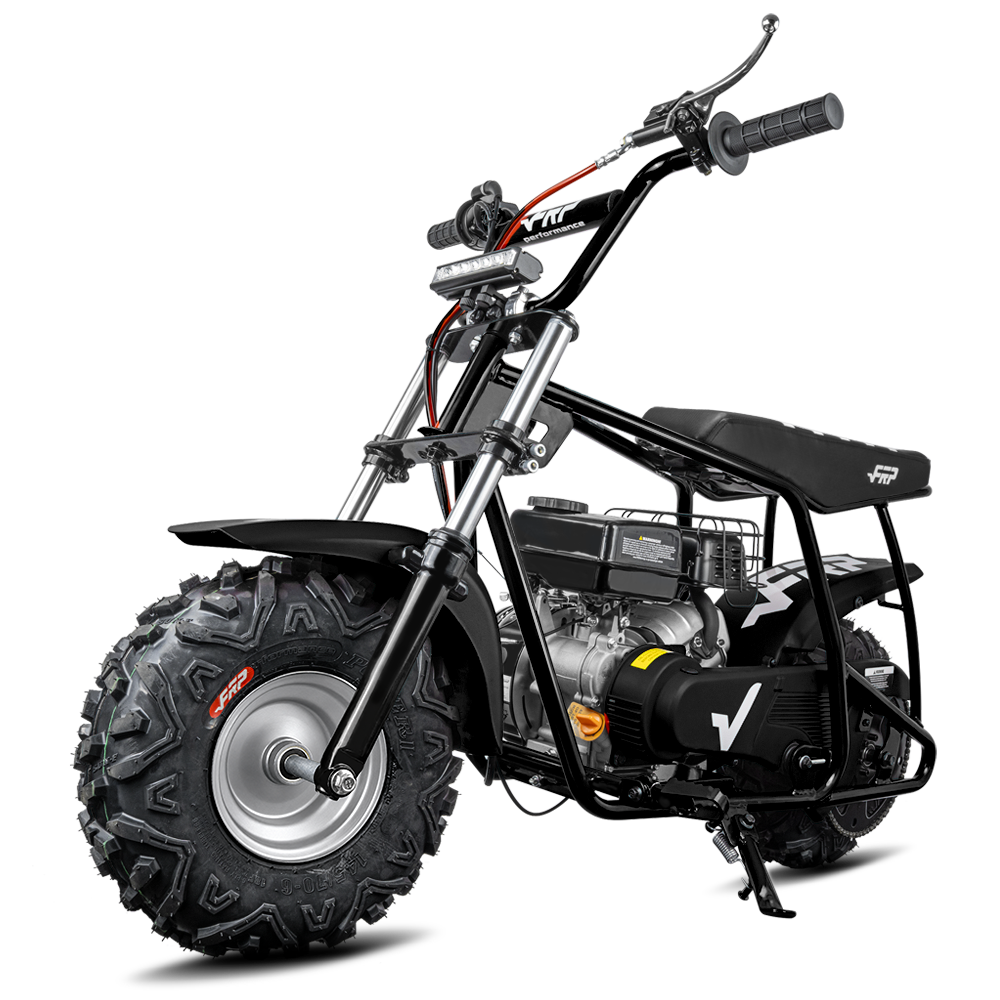
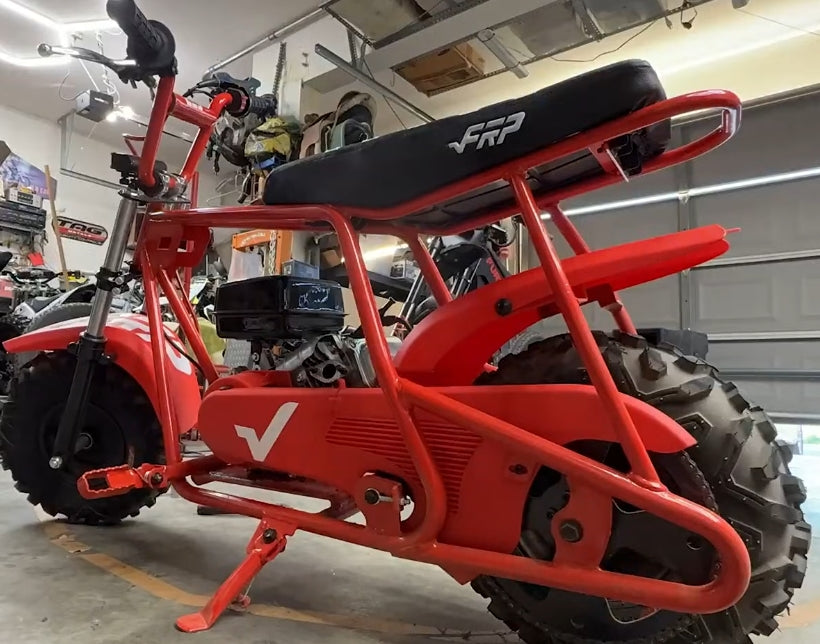
FRP Moto's 99cc GMB100 sits in the middle of this chart's stock speed classes — 28 mph out of the box, no modifications required.
If you're searching this, you probably want to know whether there's a mini bike engine class that just hits 70 mph off the shelf. There isn't. But the more useful answer is the real speed each engine class delivers — so you can match the build to what you're actually trying to do.
Mini Bike Speed by Engine Size: The Full Chart
| Engine Size | Stock Top Speed | Modified Top Speed | Typical Use |
|---|---|---|---|
| 40–50cc | 18–25 mph | 25–30 mph | Kids 6–12, first gas mini bike |
| 79–99cc | 25–28 mph | 30–35 mph | Teens, backyard adults |
| 100cc | 25–30 mph | 35–40 mph | Light trail, general adult riding |
| 196cc | 30–35 mph | 45–55 mph | Adults, trail and field use |
| 212cc (stock) | 35–40 mph | 45–55 mph | Adult performance, custom builds |
| 212cc (race build) | — | 60–70+ mph | Purpose-built competition only |
Two things to note in that table. First, the modified column assumes governor removal, optimized gearing, and in some cases a performance cam or carb — not just a loose bolt. Second, "212cc race build" is its own category: different engine internals, different drivetrain, different braking system. It's not the same engine tuned slightly higher.
Why No Stock Mini Bike Goes 70 MPH
Mini bike engines ship with governors. The governor is a mechanical RPM limiter that caps the engine before it reaches its power band. On a 212cc Predator-style engine, the governor holds the engine to roughly 3,600 RPM — the engine can physically rev to around 5,500 RPM, but not in normal operation.
Remove the governor on a stock 212cc and you're looking at 45–50 mph, maybe 55 mph with gearing changes. Still not 70 mph. To reach 70 mph on a mini bike requires:
- Governor removed
- Performance camshaft — raises the power RPM range significantly
- Larger carburetor or jet kit — matches fuel delivery to the added airflow
- Performance exhaust header — improves scavenging at high RPM
- Gearing optimized specifically for top speed over acceleration
- Upgraded connecting rod — stock rods are not rated for sustained high-RPM use
- Upgraded brakes — 70 mph on a mini bike frame requires stopping power the stock system cannot deliver
At that point you're building a racing engine that happens to be in a mini bike chassis. This happens at organized 212cc class events — riders hit these numbers — but it's not a buy-and-ride setup. Every component in the drivetrain has to match the engine output, or something fails.
What Speed Is Right for Your Actual Use Case
Backyard and private property riding: 28–35 mph is more than enough. At these speeds on a compact mini bike frame, a standard backyard feels fast. The FRP GMB100 at 99cc and 28 mph is the most common setup for this use case — fast enough to be genuinely fun, manageable in a tight space, and within the range stock brakes handle confidently.
Open field and light trail riding: 35–45 mph is the practical target. This is where a 212cc build on a solid frame makes sense. Stock 212cc speed (35–40 mph) covers most open-field use without any modifications.
Open track or organized competition: 45–60 mph. This requires a built engine, purpose-built gearing, upgraded suspension, and upgraded brakes. At this point you're sourcing engine components individually, not buying a packaged mini bike.
70 mph: Motorcycle. Mini bike frames, suspension geometry, and tire contact patches are not designed for 70 mph sustained use. Even if you build the engine to get there, the chassis becomes the failure point first.
FRP Mini Bikes: Real Speeds for Real Riders


GMB100 Frame
Engine-ready: 99cc–212cc
35–40+ mph with 212cc build
Adult performance builds
View Frame →The Brake Problem Nobody Mentions When Chasing Speed
Speed discussions focus on "how fast can I go." The more important question above 40 mph on a mini bike is: how fast can I stop?
Stock mini bike drum brakes are designed for the speed range the bike ships in. A 99cc mini bike stopping from 28 mph with drum brakes is well within spec. A 212cc build running 45+ mph with the same drum brakes is not — stopping distance increases non-linearly with speed, and drum brakes fade under repeated hard use in ways disc brakes don't.
Riders who've completed 212cc builds consistently flag this: the most common path is governor removal first, brake upgrade second. The safer sequence is the opposite — upgrade brakes before removing the governor. FRP's hydraulic brake kit is compatible with the GMB100 and GMB100 Frame chassis. If you're building for speed, plan the brakes into your budget from the start.
Focused on 212cc specifically? Our 212cc mini bike speed guide covers governor behavior, real-world test speeds by rider weight, gearing changes, and the GMB100 Frame build path.
The Frame Reality Check Above 50 MPH
Every speed discussion about mini bikes eventually hits the same ceiling — not the engine, the chassis. Mini bike frames are designed around a specific use envelope. Understanding where that envelope ends matters before building for top speed.
A stock mini bike wheelbase runs 36–42 inches. A standard motorcycle wheelbase is 55–65 inches. At low speeds (under 35 mph), the short wheelbase is a feature — the bike turns tightly and responds quickly. Above 50 mph, the same geometry creates instability that a longer wheelbase handles naturally. Riders who've pushed modified 212cc builds past 55 mph describe a specific wobble at speed — not from the engine, from the frame flexing under aerodynamic load.
The solution used in 212cc class racing: chassis reinforcement, geometry modification, and lower center of gravity through modified seat positioning. These are not bolt-on changes. Riders who build for 60+ mph speeds are effectively building a different machine around a 212cc engine, not modifying a stock mini bike upward.
The honest answer to "what cc does 70 mph": an engine capable of 70 mph isn't the hard part. A chassis rated for 70 mph sustained use is the hard part — and no mass-market mini bike ships with one.
Progressive Build Path: What to Modify in What Order
For riders who want more speed than stock and are willing to build toward it, sequence matters. The wrong order creates expensive or dangerous outcomes.
- Brakes first. Upgrade to hydraulic disc before removing the governor. Stopping distance at 45+ mph with stock drum brakes is dangerously long. This is not optional if you plan to derestrict. FRP's hydraulic brake kit fits the GMB100 and GMB100 Frame.
- Governor removal. Takes 5 minutes once brakes are upgraded. Gets you to 45–50 mph on stock 212cc.
- Gearing optimization. Adjust sprocket ratio for your use case (trail acceleration vs top speed). Bigger improvement than most builders expect — often 5–8 mph at the top end with the right ratio.
- Torque converter tuning. Adjust the shift RPM to match your riding style. Often overlooked and worth 10–15% performance improvement in how the power is delivered.
- Engine internals (cam, carb, exhaust). Only after the above are dialed in. Performance cam alone adds 3–5 mph at the top. Cam + carb + exhaust together gets to 55–65 mph range on a built 212cc.
Most riders who've gone through this process report the biggest real-world improvement comes from steps 1–3, not the engine internals. The governor removal + brake upgrade + gearing change typically delivers 80% of the available performance gain at 20% of the cost of a full engine build.
Frequently Asked Questions
What cc goes 70 mph on a mini bike?
No stock cc class goes 70 mph on a mini bike. A purpose-built 212cc race engine with performance cam, carb, exhaust, connecting rod upgrade, governor removal, and optimized gearing can reach 60–70+ mph. This is a full engine build, not an off-the-shelf configuration.
What cc mini bike goes 50 mph?
A 212cc mini bike with the governor removed and gearing optimized for top speed can reach 45–55 mph. A 196cc with similar modifications hits a comparable range. Neither achieves this stock.
How fast does a 99cc mini bike go?
25–28 mph stock. With gearing changes some 99cc builds push to 30–33 mph, but displacement caps the power ceiling well below 212cc regardless of modifications.
Is a 196cc or 212cc faster on a mini bike?
In stock form the difference is about 5–7 mph: 196cc typically reaches 30–35 mph and 212cc reaches 35–40 mph. With modifications, both classes reach similar ranges — the 212cc has slightly more headroom for performance parts.
Does engine cc directly determine top speed?
CC determines displacement and broadly power potential. But gearing ratio, rider weight, terrain, and governor settings each have significant impact on actual top speed. A well-geared 196cc can outrun a stock 212cc in many real-world setups.
Can I make a stock mini bike go 60 mph?
Not safely on a stock mini bike. Reaching 60 mph requires engine modifications (cam, carb, exhaust, governor removal), optimized gearing, and a chassis rated for that speed — including hydraulic brakes, upgraded suspension, and structural frame capacity. A stock mini bike chassis is not engineered for 60 mph use.