
TL;DR
A 212cc mini bike, with standard gearing and the governor removed, usually reaches 30–38 mph. With the governor left in place, expect 25–30 mph. Actual speed depends on rider weight, sprocket ratio, tire size, terrain, and engine condition. Some performance builds with upgraded gearing reach 38–45 mph, but those require matched brakes, a matched drivetrain, and rider experience. A stock FRP Moto GMB100 with its 99cc engine tops out around 20–25 mph — a good fit for beginners. If you're planning a 212cc build for more speed, the FRP Moto upgraded frame is a solid starting point.
The Direct Answer
Under standard conditions, with the governor removed and standard gearing, a 212cc mini bike runs about 30–38 mph. With the governor left in place, the real-world figure is 25–30 mph. These are estimates, not guarantees — actual speed is shaped by the five practical factors below.
For reference, the stock 99cc FRP Moto GMB100 tops out around 20–25 mph, which is a better starting point for new and younger riders. A 212cc engine is a significant step up from there — and that step shows up not just in speed, but in braking demands, drivetrain load, and how much more the bike asks of the rider.
The speed number itself isn't what matters — the system behind it is. A 212cc mini bike that hits 35 mph needs brakes, gearing, and an experienced rider to match.

Why This Question Comes Up
Speed is usually the first thing people think about when choosing a mini bike. A rider comparing 99cc and 212cc setups wants to know the real difference between them. A parent wants to know whether the bike is too fast for a younger rider. A builder wants to understand what the engine actually does before buying parts.
The 212cc engine — often called the Predator 212 after Harbor Freight's popular version — has become one of the most common mini bike upgrade engines, because it fits a wide range of mini bike frames and puts out clearly more power than a stock 99cc engine. That popularity has also produced a lot of unverified speed numbers: some sources claim top speeds that only a full performance build can reach, while others give conservative low figures that don't reflect a properly tuned setup.
The speed estimates in this article reflect a bike in good running condition, standard gearing, and rider weight, because those are the variables that actually determine how fast your bike will go.
What Determines a 212cc Mini Bike's Top Speed
Five factors determine the real top speed of any 212cc mini bike. There's no single number that applies to every build.
1. The Governor
The governor is a mechanical device inside the engine that limits maximum RPM, which limits top speed. With the governor set to its factory position, a 212cc engine typically caps out around 25–30 mph depending on gearing. With the governor adjusted or removed, that range rises to 30–38 mph or beyond on a performance build. The governor section below explains this in more detail, including the safety considerations involved.
2. Gearing and Sprocket Ratio
The ratio between the engine's drive sprocket and the rear axle sprocket determines how the engine's power translates to ground speed. A smaller rear sprocket means more top speed but slower acceleration. A larger rear sprocket means stronger acceleration but lower top speed. This is one of the most practical tuning tools available without changing the engine itself. The gearing section below includes a simple reference table.
3. Rider Weight
A heavier rider requires more power to reach the same speed as a lighter rider on the same bike. A 212cc mini bike that reaches 36 mph with a 140-pound rider may top out at 30 mph with a 200-pound rider. This is not a limitation of the engine brand — it is basic physics. Every speed estimate should be read with this in mind.
4. Tire Size
Larger tires effectively change the gearing ratio. A bigger tire travels more ground per wheel revolution, which means more top speed at the same engine RPM — but also slower acceleration. Smaller tires do the opposite. Most stock mini bike builds use tires in the 4.10-3.50-6 or 4.10-6 range, which pair well with standard sprocket setups.
5. Terrain
Flat, hard-packed dirt or asphalt gives the highest achievable speed. Loose gravel, grass, or inclines reduce it significantly. Real-world top speeds are almost always lower than theoretical maximums because terrain conditions vary.
212cc Mini Bike Speed Estimates
The table below shows estimated speed ranges across common configurations. These are approximate figures based on standard builds — not guaranteed top speeds. Rider weight, tire choice, terrain, and engine condition all affect the actual result.
| Engine | Configuration | Estimated Top Speed |
|---|---|---|
| 99cc stock mini bike | Stock setup | 20–25 mph |
| 212cc (governor on) | Standard gearing | 25–30 mph |
| 212cc (governor removed) | Standard gearing | 30–38 mph |
| 212cc | Performance gearing + upgrades | 38–45 mph (experienced builders only) |
All estimates assume flat terrain, a rider in the 140–160 lb range, and a bike in good working condition. Actual speeds vary.
The 38–45 mph range at the top of the table requires more than a 212cc engine. It requires matched brakes, a properly set-up drivetrain, and a rider with real experience controlling the bike at those speeds on private property. It is not a standard configuration and should not be treated as a baseline.
The Governor: What It Is and What Removing It Changes
The governor is a mechanical RPM limiter built into the engine. It senses the speed of a spinning component inside the crankcase and uses a lever arm to reduce throttle input when the engine approaches its set RPM ceiling. On most stock 212cc engines, the governor limits the engine to roughly 3,600 RPM, which constrains top speed.
What changes when the governor is adjusted or removed
Adjusting the governor allows the engine to rev higher, which increases top speed on the same gearing. Removing it entirely eliminates the RPM ceiling — the engine can now rev to its mechanical limit, which produces noticeably more speed but also introduces serious risks.
Without a governor, the engine can over-rev if the throttle is held wide open on a long flat run or if the rear wheel lifts momentarily and then re-contacts the ground. Over-revving can cause engine failure in seconds: connecting rod failure, valve float, and bearing damage are all possible outcomes. These failures are sudden and potentially dangerous to the rider.
The other risk is behavioral. A bike that was predictable at 28 mph with the governor in place is a different machine at 36 mph without it. Braking distances are longer, the consequences of a mistake are higher, and the demands on the rider's skill and reaction time are greater.
The honest position on governor removal
Governor removal is a decision for experienced adult riders with the matching setup — appropriate brakes, proper gearing, good riding surface, and the experience to manage higher speeds confidently. It is not a beginner modification, and it is not appropriate for younger riders.
If you are asking how fast a 212cc mini bike goes because you want to know whether the stock setup is enough for your riding goals, the governor-on estimate of 25–30 mph is the right reference point. That number is still a significant step up from a 99cc setup and is enough speed to require real protective gear, good braking, and a suitable riding location.
Gearing and Sprocket Ratio
The sprocket ratio is the relationship between the number of teeth on the front (drive) sprocket and the number of teeth on the rear (axle) sprocket. A simple formula describes the relationship: a smaller rear sprocket increases top speed; a larger rear sprocket increases torque and acceleration.
This means you can tune the speed behavior of a 212cc build without touching the engine at all. Swapping the rear sprocket is one of the most common and practical adjustments a builder makes when dialing in a mini bike for their riding style and terrain.
| Rear sprocket change | Effect on top speed | Effect on acceleration | Good for |
|---|---|---|---|
| Smaller rear sprocket (fewer teeth) | Higher top speed | Slower off the line | Flat terrain, speed-focused builds |
| Larger rear sprocket (more teeth) | Lower top speed | Stronger pull from a stop | Hills, loose terrain, heavier riders |
| Stock sprocket ratio | Baseline estimate | Balanced | General-purpose riding |
The important note here is that chasing top speed by dropping rear sprocket teeth without also reviewing brakes and chain condition is an incomplete plan. A faster setup requires stopping power that matches the new speed, not just more teeth removed from the sprocket.
For a deeper look at how the drivetrain choice affects the whole build, read Do I Need a Torque Converter for a 212 Mini Bike Build?
How the FRP Moto GMB100 Fits Into This
FRP Moto makes one mini bike that fits two different rider paths depending on where someone is in their experience and build goals.
Path A: The complete GMB100 for riders who want to ride now
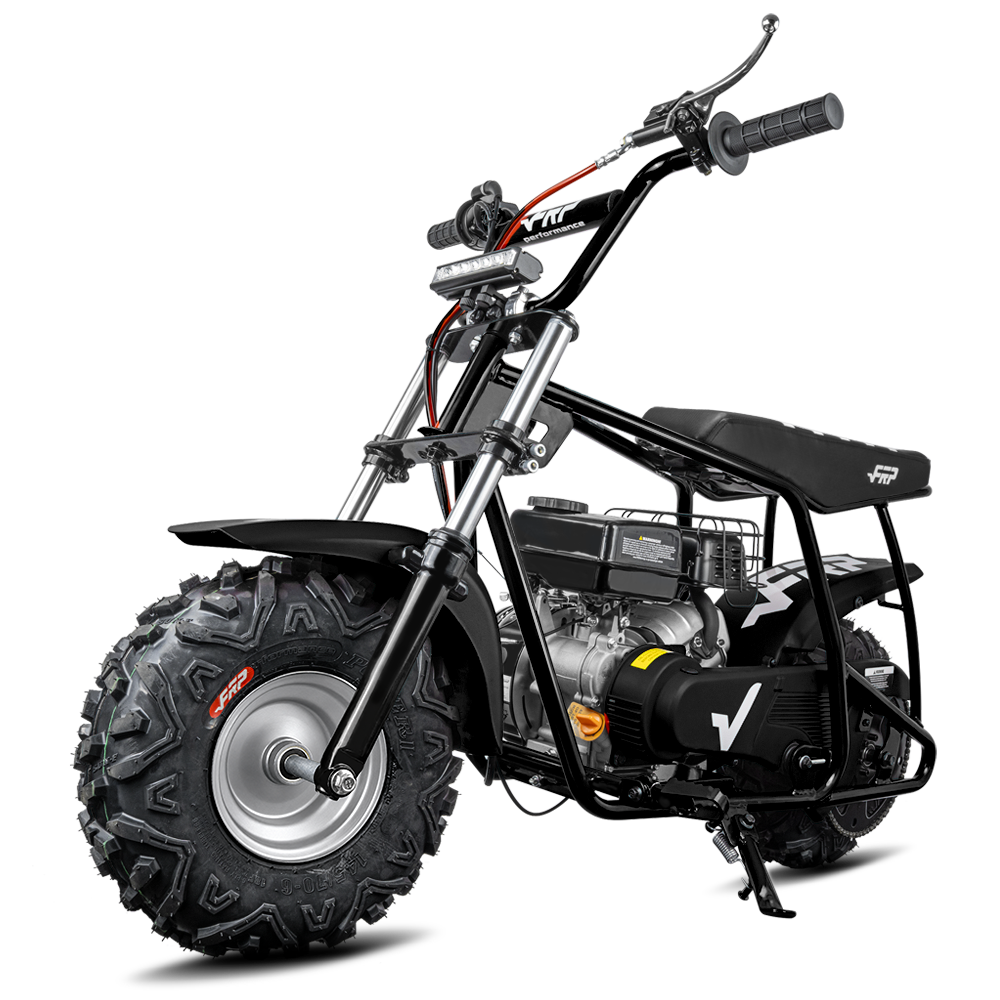
The FRP Moto GMB100 complete mini bike runs a 99cc engine in its stock configuration and reaches approximately 20–25 mph. That speed is intentional — it is appropriate for a first real gas mini bike, for younger riders, and for riders who are still building throttle control and braking habits. The bike is set up and ready to ride, not a project.
For most new riders and families, 20–25 mph is not a limitation. It is a controllable introduction to gas mini bike riding on private property. Riders who build real habits at that speed are better prepared for upgrades later.
Path B: The GMB100 upgraded frame for a 212 build
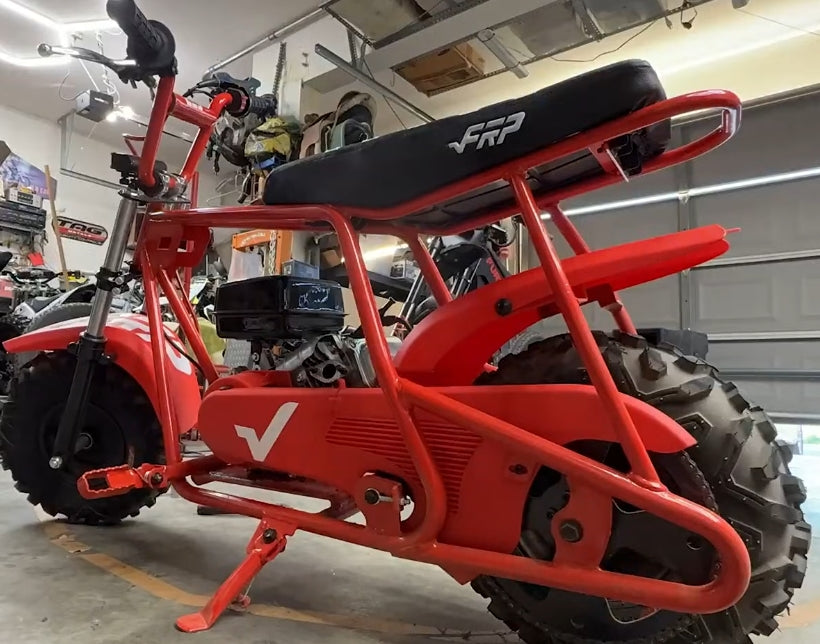
Riders who want to build a 212cc setup — and who have the experience and riding context to justify it — should start with the FRP Moto GMB100 upgraded frame. It is designed to accommodate a larger engine, matching drivetrain components, and the supporting parts a 212 build requires.
Starting with the right frame matters because a 212cc engine produces more torque than a 99cc setup. That torque goes through the drivetrain, which affects chain load, clutch or torque converter behavior, and frame stress. A frame built for that load is the right foundation — not a cost-cutting starting point that creates problems after the engine is installed.
Before planning a 212 build, read Is a 212 Swap Cheaper Than Modding the Stock FRP GMB100 Motor? for the full picture on build cost and decision logic. And for the physical installation steps, see How Do I Mount a 212 Engine on a GMB100 Mini Bike?
Build-platform parts — upgraded frame, torque converter, exhaust, chain, and brake hardware — are in the FRP Moto upgraded parts collection.
Safety Boundary
Mini bikes are for private property and off-road use only. They are not street legal and should not be ridden on public roads, sidewalks, or paths shared with vehicle traffic. Always wear a helmet and full protective gear before riding, regardless of speed.
Speed articles can make fast riding sound straightforward. It is not. Here is what changes as speed increases on a mini bike:
- Braking distance increases significantly. A mini bike that stops in 15 feet at 20 mph requires much more distance at 35 mph. Standard drum brakes on many mini bikes were sized for lower-speed operation. If the speed goes up and the brakes do not, stopping power becomes the limiting safety factor. Read Does a 212 Swap Require Better Brakes? before finalizing a 212 build.
- Reaction time demands increase. At 25 mph, a rider has more time to process and respond to an obstacle. At 38 mph, an obstacle appears and requires action in roughly half the time. This is not a solvable problem with more engine; it requires experience, situational awareness, and appropriate riding surfaces.
- Fall consequences scale with speed. A low-speed fall at 20 mph on a helmet-and-gear rider is a very different outcome than a fall at 38 mph without proper protection. Speed data in this article is provided for planning, not as a target to chase without matching safety preparations.
- Mechanical failures become more consequential at higher speeds. A chain that slips at 20 mph is a problem. The same failure at 35 mph is a more serious safety event. Regular pre-ride inspection — chain tension, brake function, throttle return, tire condition — matters more as the build gets faster.
The safety floor for any speed above 25 mph is: a helmet rated for motorized riding, gloves, eye protection, long sleeves and pants at minimum, and ideally chest and knee protection. That is not optional equipment for a 212cc build.
Speed curiosity is normal. Matching safety preparation to the actual speed of your setup is what makes riding sustainable long-term.
FAQ
How fast does a 212cc mini bike go?
A 212cc mini bike typically goes 25–30 mph with the governor in place and standard gearing. With the governor removed, the range rises to approximately 30–38 mph. Performance builds with upgraded gearing can reach 38–45 mph, but those setups require matched brakes, drivetrain components, and experienced riders. Actual speed depends on rider weight, sprocket ratio, tire size, terrain, and engine condition.
How fast does a stock 99cc mini bike go?
A stock 99cc mini bike, including the FRP Moto GMB100 in its out-of-box configuration, typically reaches approximately 20–25 mph. This is the appropriate speed range for new riders and younger riders learning throttle and brake control on private property.
Does removing the governor make a mini bike faster?
Yes, removing or adjusting the governor allows the engine to rev higher and increases top speed. However, it also removes an RPM safety ceiling that protects the engine from over-revving and removes a built-in speed limit that helps keep the bike predictable for less experienced riders. Governor removal should only be done on a build that has matching brakes, appropriate gearing, and an experienced rider.
What is a mini bike governor?
A governor is a mechanical device inside the engine that limits how high the engine can rev. It senses a spinning component inside the crankcase and reduces throttle input when the engine approaches its set RPM limit. On a stock 212cc engine, the governor typically limits RPM to around 3,600 RPM, which constrains top speed. It protects the engine from over-revving and limits speed for safety.
What sprocket size makes a mini bike go faster?
A smaller rear sprocket (fewer teeth on the axle sprocket) increases top speed by changing the gear ratio. A larger rear sprocket increases pulling power and acceleration but reduces top speed. Changing sprocket size is one of the most practical gearing adjustments available without modifying the engine. Any sprocket change should be accompanied by a chain tension check and brake review to match the new speed behavior.
Does rider weight affect mini bike top speed?
Yes. A heavier rider requires more power to reach the same speed as a lighter rider on the same setup. A 212cc mini bike that reaches 36 mph with a 140-pound rider may top out at 30 mph or less with a 200-pound rider. Every published speed estimate should be read as a range that varies with rider weight.
How fast is a Predator 212 mini bike?
A mini bike running a Predator 212 engine follows the same speed estimates as any 212cc setup: approximately 25–30 mph with the governor in place, 30–38 mph with the governor removed and standard gearing, and up to 38–45 mph on performance-geared builds. The Predator 212 is the most common 212cc engine used in mini bike builds due to its wide availability and common mounting dimensions.
Is a 212cc mini bike too fast for kids?
In most cases, yes. A 212cc mini bike at 30–38 mph is beyond the appropriate speed range for most children, particularly those who are new to gas mini bikes. The braking distances, reaction time demands, and fall consequences at those speeds require experience and physical size that most younger riders do not yet have. A stock 99cc setup at 20–25 mph is the appropriate starting point for young or first-time riders.
What is the top speed of an FRP GMB100?
The FRP Moto GMB100 in stock configuration with a 99cc engine reaches approximately 20–25 mph. This is its intended operating range for a beginner or younger rider. The GMB100 upgraded frame is designed to support a 212cc build for riders who want more power, but that is an advanced project, not the stock bike's speed profile.
How do I make my 212 mini bike faster safely?
The safest way to increase speed on a 212cc build is through gearing adjustment — reducing the size of the rear sprocket. Before chasing more speed, confirm that brakes are in good condition and appropriate for the current speed, that chain tension and alignment are correct, and that the rider has the experience to manage higher speeds safely. Speed increases on a mini bike should always come with matching safety preparations, not just faster parts. Only ride on private property with full protective gear.
What to Read Next
This article is part of FRP Moto's 212 build series. If your curiosity about speed is turning into actual build decisions, these are the articles to read next:
- Is a 212 Swap Cheaper Than Modding the Stock FRP GMB100 Motor? — the pillar article comparing the real cost of keeping the 99cc engine versus a full 212 swap.
- How Do I Mount a 212 Engine on a GMB100 Mini Bike? — the actual installation steps, clearance requirements, and mounting hardware choices.
- Does a 212 Swap Require Better Brakes? — the brake-upgrade question, directly tied to the speed figures in this article.
- Do I Need a Torque Converter for a 212 Mini Bike Build? — how the drivetrain choice affects speed, torque delivery, and performance.
- FRP Moto Answers — the complete hub for ownership and assembly questions.