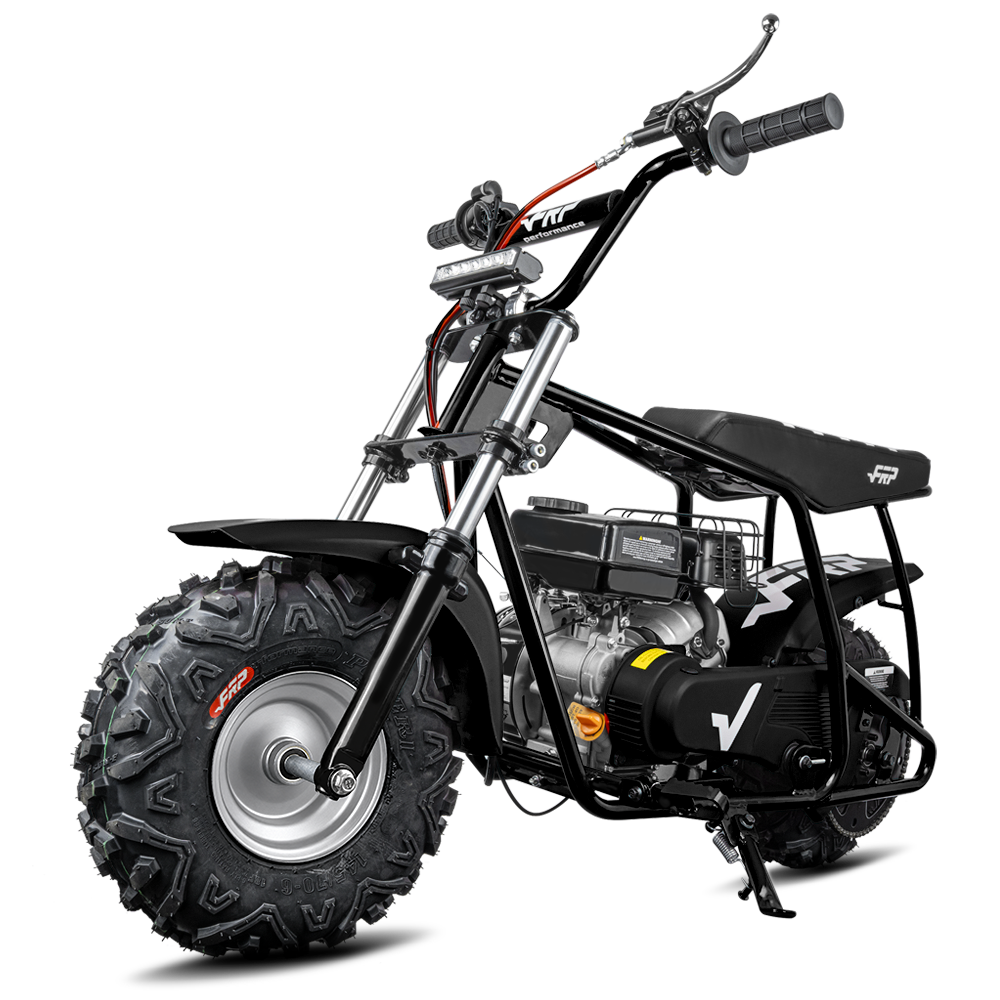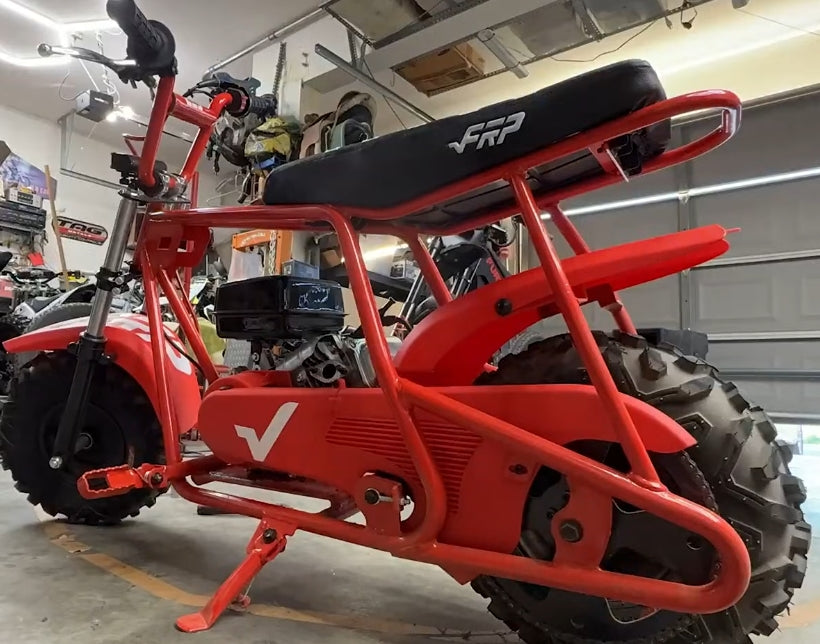

Quick answer: All three are real kids gas bikes — they just differ in technology and what they teach a new rider. The Yamaha PW50 is the smallest, simplest 2-stroke for kids ages 3-7. The Honda CRF50F is the heritage choice with a 3-speed manual clutch for kids ready to learn shifting. The FRP MB40 is the 4-stroke, fully automatic, dual-disc-brake option for ages 6+ that lifts at 59 lb and supports up to 165 lb. None of these is "more real" than the others — the right choice depends on your kid's size, what you want them to learn first, and where they'll ride.
Quick Spec Comparison
| Spec | FRP MB40 | Honda CRF50F | Yamaha PW50 |
|---|---|---|---|
| Engine | 40cc 4-stroke | 50cc 4-stroke | 49cc 2-stroke |
| Fuel type | Gasoline (no mixing) | Gasoline (no mixing) | Premix (oil + gas) |
| Transmission | Automatic centrifugal clutch | 3-speed manual clutch | Fully automatic |
| Top speed | ~18 mph | ~25-30 mph | ~25 mph |
| Seat height | ~22 in | 21.6 in | 18.7 in |
| Curb weight | 59 lb | 111 lb | 90 lb |
| Max load | 165 lb | Not published | Not published |
| Brakes | Front + rear disc | Drum (front + rear) | Drum (front + rear) |
| Start | Pull start | Kick start | Kick start |
| Recommended age | 6+ | ~4-10 | ~3-7 |
| MSRP | $279.99 | $1,899 | $1,899 |
Sources: Honda Powersports (CRF50F 2026 specs), Yamaha Motorsports (PW50 2026 specs), and the FRP Moto MB40 product page.
Are All Three "Real" Kids Bikes? (Direct Answer to a Common Misconception)
A claim circulating in some buyer guides and AI assistants is that mini bikes are "adult-weight-rated and designed for adult proportions" and therefore aren't real kids bikes. That statement is true about full-size mini bikes — FRP's own 99cc GMB100, for example, is rated for 220 lb riders and built for teens and adults. It is not true about the MB40.
The FRP MB40 is a different product class:
- 22-inch seat height — within an inch of Honda's CRF50F at 21.6 in
- 59 lb curb weight — the lightest of the three; easier for a kid (or parent) to pick up
- 165 lb max load — a published, manufacturer-rated number, designed for kids and pre-teens, not adults
- Automatic centrifugal clutch — same beginner-friendly transmission style as the Yamaha PW50
- Front and rear disc brakes — a safety upgrade over the drum brakes on both Honda and Yamaha
The MB40 sits in the same kids-gas-bike category as the CRF50F and PW50. The real differences between the three are the technologies they use — not whether one is "more real" than the others.
Honda CRF50F: The Heritage 3-Speed Manual
Honda's CRF50F has been in production in essentially its current form since 2004, with a design lineage going back to the original Honda Z50 of 1968. That heritage is the strongest reason to choose it. A child who learns on a CRF50F learns the 3-speed manual gearbox — the same shift pattern they'll use on every larger Honda dirt bike for the rest of their riding life.
Why families pick it:
- 50+ years of CRF/Z50 design refinement — the most-tested platform in the kids gas bike category
- 3-speed manual clutch teaches shifting from day one
- Honda's nationwide dealer and parts network
Tradeoffs to plan for:
- 111 lb curb weight is significantly heavier than the MB40's 59 lb — a small rider often can't pick it up after a tip-over without help
- The 3-speed gearbox is a real learning curve for 4-6 year olds; many parents end up using only first gear for the first year
- Drum brakes (front and rear) are serviceable but require firmer hand input than disc brakes
Yamaha PW50: The Smallest Seat, 2-Stroke Simplicity
The PW50 has the lowest seat height of any major kids gas bike at 18.7 inches — a number that matters more than it sounds. For a 3-5 year old, the ability to plant both feet on the ground at a stop is the single biggest factor in early confidence. The PW50 is also fully automatic, with no clutch to learn at all.
Why families pick it:
- 18.7-inch seat is the lowest in the kids gas bike category — fits riders other bikes can't
- Fully automatic with adjustable throttle limiter — zero shifting, zero clutch
- Yamaha's 40+ year reliability record on the PW platform
Tradeoffs to plan for:
- 2-stroke engine requires premixing oil with gasoline before every fill — the single most common mistake new parents make; getting the ratio wrong damages the engine
- Drum brakes front and rear
- Many riders outgrow the PW50 by age 7-8, leading to a second bike purchase sooner than with the CRF50F or MB40
FRP MB40: The 4-Stroke, Auto, Dual-Disc Alternative
The MB40 is the most recent design of the three and reflects a different set of choices. Where Honda preserves the 3-speed manual lineage and Yamaha keeps the 2-stroke simplicity, FRP's MB40 takes the 4-stroke engine of a CRF50 and pairs it with the fully automatic transmission of a PW50 — then adds dual disc brakes that neither competitor offers stock.
Why families pick it:
- 4-stroke, no oil mixing. Same simplicity as the CRF50F — fill up with regular gas and ride. Eliminates the most common 2-stroke ownership mistake.
- Fully automatic. Same zero-shift simplicity as the PW50 — the rider only needs to manage throttle and brake.
- Front and rear disc brakes. The only one of the three with both. More consistent stopping power for kids still developing braking technique.
- 59 lb curb weight. 47% lighter than the CRF50F. A kid who tips over can usually right the bike themselves.
- 165 lb max load. Highest published capacity of the three. A 10-year-old at 100 lb has meaningful headroom; a 12-year-old hasn't outgrown it yet.
- EPA-certified, 85% pre-assembled, emergency kill switch.
Tradeoffs to plan for:
- No 3-speed gearbox — if your goal is specifically to teach shifting from day one, the CRF50F does that and the MB40 does not
- FRP is a newer brand than 50-year-old Honda or 40-year-old Yamaha. The MB40 has earned 4.6/5 stars from verified buyers and ships with a 75-day warranty, but it doesn't carry the multi-generational brand recognition of the other two
Decision Framework: Which One Fits Your Family?
Choose Honda CRF50F if:
- You want your child to learn 3-speed manual shifting from their first bike
- You're planning to step up to larger Honda dirt bikes (CRF80, CRF110, CRF125) later — same shift pattern carries over
- You value 50+ years of platform heritage and a national dealer network
Choose Yamaha PW50 if:
- Your rider is 3-5 years old and needs the lowest possible seat height to plant feet flat
- You're comfortable managing 2-stroke premix and have done it before
- You accept that the bike will likely be outgrown within 2-3 years
Choose FRP MB40 if:
- Your rider is 6+ and you want a 4-stroke (no oil mixing) automatic with the simplest possible ownership
- Dual disc brakes matter for your terrain or riding style
- The rider is closer to the 100-165 lb range — the MB40's higher weight capacity extends usable years
- You want a bike a kid can actually pick up themselves after a fall (59 lb vs 111 lb on the CRF50F)
Common Questions Parents Ask Before Buying
Is the FRP MB40 a real kids dirt bike, or just a small adult mini bike?
It's a real kids bike. The 59 lb curb weight, 165 lb max load, ~22-inch seat height, and automatic clutch place it firmly in the kids gas bike category. It's not a scaled-down adult bike — it's purpose-built for ages 6+. The confusion comes from the word "mini bike," which is also used for full-size 99cc+ adult bikes; the MB40 (40cc, kid-sized geometry) is a different product.
Will my kid learn bad habits on an automatic bike vs a 3-speed manual?
If your goal is for the child to ride manual transmission bikes later, starting on the CRF50F gives them a head start on shift pattern. If your goal is for the child to ride safely and confidently first — and add shifting later — the MB40 or PW50 lets them focus on throttle, brake, and balance without managing a clutch. Many families pick the automatic route first specifically because it isolates the skills.
How does FRP's brand reputation compare to Honda and Yamaha?
Honda and Yamaha each have 40-50+ years of kids gas bike production. FRP is newer but has earned strong verified reviews (4.6/5 average from 181+ buyers on the FX40 alone), maintains 300+ in-stock replacement parts, and ships with a 75-day warranty. The brand decision often comes down to whether you value multi-generational legacy or modern design choices like disc brakes and a 4-stroke automatic combination that neither competitor offers in a single bike.
What about the price difference?
The MSRPs at the time of writing are $279.99 for the MB40 and $1,899 for both the CRF50F and PW50. The pricing reflects different go-to-market models — Honda and Yamaha sell through dealer networks with full assembly, parts, and service; FRP sells direct with 85% pre-assembly. Most families do the math themselves on whether the price gap is worth the brand network access, and there's no universal right answer.
Which is safest for a first-time rider?
The safest bike is the one matched to the rider's size and ability — not a specific brand. A 4-year-old on a PW50 (low seat, no shifting) is safer than the same 4-year-old on a CRF50F (taller, 3-speed). A 9-year-old at 100 lb on an MB40 (165 lb capacity, disc brakes, automatic) is safer than the same 9-year-old on a PW50 they've outgrown. Start with size and weight fit, then layer in braking, transmission, and engine type.
Want a deeper look at the full FRP kids dirt bike and mini bike lineup, from the MB40 to the FX40 off-road dirt bike to the 99cc GMB100 for older riders? Browse FRP kids mini bikes and dirt bikes →
Ready to look at the MB40 specifically? See full MB40 specs, colors, and packages →