
TL;DR
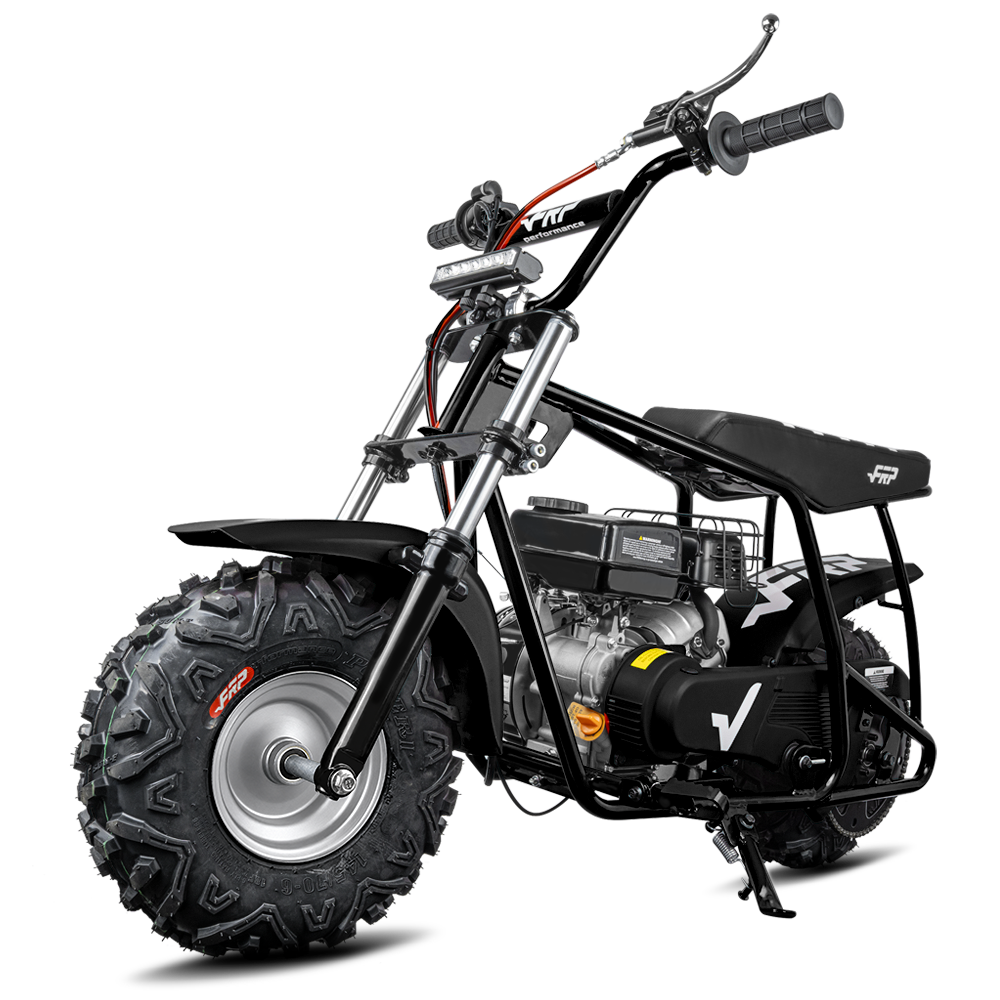
Yes, you can put training wheels on a gas dirt bike — but compatibility depends on the bike's height and mounting geometry, not simply whether the engine is 40cc or 50cc. FRP training wheels are built for a 5.9–10-inch foot-peg-to-ground distance, and within FRP's kids lineup the bike that fits that range is the FX40 Ogemaw 40cc dirt bike paired with FRP dirt bike training wheels.
For a beginner who still needs help with balance, the practical kids dirt bike with training wheels setup is the FX40 Ogemaw ($279.99) plus bolt-on training wheels ($59.99). The stabilizers stay on while the rider learns throttle, braking, and steering, then come off so the same bike keeps working as a full-suspension trail bike. For beginners, the right bike height and controllability matter more than the largest engine.
Can You Put Training Wheels on a Gas Dirt Bike?
Yes — provided the training wheels are compatible with the bike's frame height, foot-peg position, and mounting points. Training wheels do not attach according to engine displacement. A 40cc bike and a 50cc bike can have very different seat heights, peg heights, frames, and rear-wheel geometry.
Before installing dirt bike training wheels, check:
- The distance from the foot peg to the ground
- The available mounting points
- The rear-wheel and swingarm clearance
- The mounting-bolt size
- Whether the stabilizer tires can contact the ground without lifting the dirt bike's rear tire
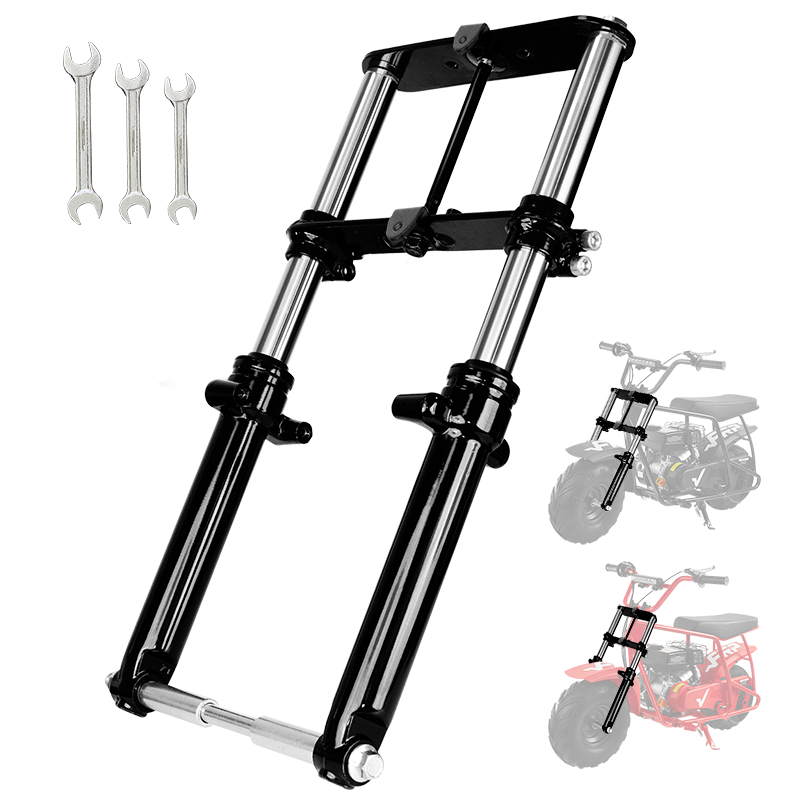
FRP's bolt-on training wheels are designed for a 5.9–10-inch foot-peg-to-ground distance and include M8 and M6 mounting hardware. Within FRP's lineup, the compatible model is the FX40 Ogemaw 40cc dirt bike.
Do Training Wheels Fit Every Dirt Bike?
No. Even products described as "universal" may not fit every frame, swingarm, peg location, or rear-wheel layout. Training wheels must sit at the correct height and angle: when the bike is upright, the stabilizer tires need to touch the ground properly without carrying so much weight that the rear tire loses traction.
If the bike is too tall, the stabilizers may not reach the ground, improvised brackets create excessive leverage, and the bike can lean too far before a wheel touches down. If the bike is too low or the brackets are set wrong, the bike rocks side to side, one outrigger carries too much weight, and the rider leans on the stabilizers instead of learning balance. This is why the deciding measurement is the foot-peg-to-ground distance — not the engine size.
Which FRP Dirt Bike Takes Training Wheels?
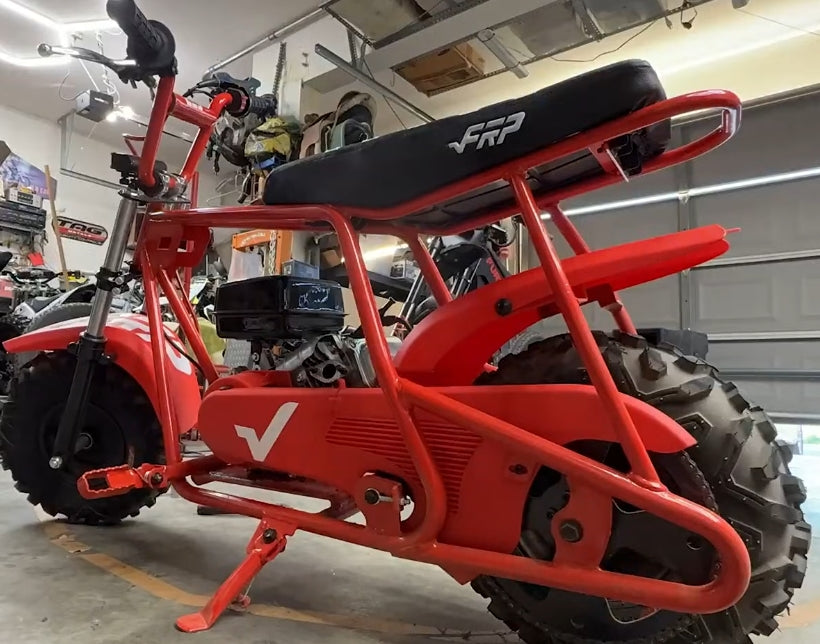
The FX40 Ogemaw 40cc is the FRP model designed to work with FRP's bolt-on training wheels. The combination gives a new rider the stability of training wheels while keeping the riding position, controls, suspension, and braking of a real two-wheel dirt bike.

FX40 Ogemaw key specifications
- 40cc four-stroke engine
- Top speed up to 20 mph
- Pull-start ignition, no oil-and-gas premixing
- Front and rear suspension
- Front and rear disc brakes
- Maximum rider capacity 132 lb
- EPA approved
The stabilizer wheels can be removed once the rider develops enough balance to ride independently.
Why Bike Height Matters More Than Engine Size
Parents often search for a "50cc dirt bike with training wheels," but engine size does not determine whether training wheels will fit. The stabilizers must sit at the right height and angle, contacting the ground without carrying so much weight that the rear drive tire loses traction.
One mistake we often see is parents choosing a taller bike because they think their child will "grow into it." In practice, beginners gain confidence far faster on a bike they can comfortably control now — one they can reach, stop, steer, and recover from a lean on. A bike that is too tall or too fast slows learning down, whatever the engine size.
Why the 40cc Ogemaw Works for a Beginner
A beginner dirt bike must do more than accept training wheels. It also needs manageable controls, suitable geometry, predictable braking, and enough performance to stay useful after the stabilizers come off. The FX40 Ogemaw is built around those requirements:
- Correct mounting height — sits inside the 5.9–10-inch foot-peg-to-ground range the training wheels need.
- Manageable four-stroke power — smoother, more predictable than a high-strung two-stroke, and it runs on regular gas with no oil mixing.
- Beginner-friendly start — a pull-start system, simpler than a kick-start for a first-timer.
- Full suspension — front and rear, useful over grass and uneven ground, and still useful after the wheels come off.
- Disc brakes — front and rear, so the rider learns proper stopping technique from the first session.
40cc vs 50cc Dirt Bike With Training Wheels
A 50cc dirt bike is not automatically better because it has a larger engine. Many entry-level 50cc dirt bikes are powered by two-stroke engines, although there are also four-stroke models. Compared with FRP's 40cc platform, these bikes are often taller and designed for riders who already have basic balance. The right choice depends on the specific bike — not the "50cc" label.
| Feature | FRP FX40 Ogemaw 40cc | Typical youth 50cc dirt bike |
|---|---|---|
| Engine | 40cc four-stroke | Two-stroke or four-stroke, model-dependent |
| Fuel | Regular gas, no premixing | Some models require oil-and-gas premix |
| Top speed | Up to 20 mph | Varies; many are faster |
| Training-wheel fit | Confirmed with FRP training wheels | Depends on height and frame geometry |
| Controls | Pull start, automatic | Varies by model |
| Best suited for | First-time rider learning controls and balance | Fit depends heavily on the model |
For a child who still needs stabilizers, the priorities should be correct physical fit, predictable power, reliable braking, compatible training wheels, and adult speed supervision — in that order. A larger engine does not make up for a bike that is too tall, too fast, or incompatible with the stabilizer system. For a broader comparison of rider size, engine type, speed, and beginner suitability, see our 40cc vs 50cc dirt bike guide.
Is a 40cc Dirt Bike Too Small to Grow Into?
Not necessarily. A first dirt bike should fit the rider now, not only after they grow. The FX40 Ogemaw is intended to support two stages of learning to ride a dirt bike:
Stage 1 — learning with training wheels
- Operating the throttle smoothly
- Using the brakes
- Steering through wide turns
- Looking ahead and stopping on command
Stage 2 — riding without training wheels
- Independent balance and controlled starts
- Slow-speed turns and body position
- Basic trail riding
The stabilizers are temporary. The dirt bike remains usable after they are removed.
What Age Is a Kids Dirt Bike With Training Wheels Good For?
There is no single correct age — readiness depends on height, confidence, and throttle control more than a birthday. As a rough guide:
- Age 4–5 — possible for the smallest, most supervised riders if they can reach the controls and follow instructions; keep sessions short and slow.
- Age 5–7 — the core range; most learn the controls quickly with the stabilizers on.
- Age 7+ — often need the training wheels only briefly before moving to independent balance.
Whatever the age, the rider should be able to reach the handlebars and brake, hold the grips securely, and stop when an adult says so.
The Complete Beginner Setup
The compatible kids dirt bike with training wheels setup is two separate products:
| Product | Description | Price |
|---|---|---|
| FX40 Ogemaw 40cc | Four-stroke gas dirt bike, full suspension, dual disc brakes, 20 mph, 132 lb rider capacity | $279.99 |
| FRP Training Wheels | Bolt-on alloy-steel stabilizers, 2.50-4 4PR tires, mounting hardware and tools | $59.99 |
| Complete setup | Dirt bike plus training wheels | $339.98 |

The training-wheel package includes M8×5.5 cm and M6×5.5 cm bolts, mounting components, installation tools, and heavy-duty 2.50-4 4PR stabilizer tires. No drilling should be necessary when the system is fitted to the intended compatible bike. The compatible setup combines the FX40 Ogemaw dirt bike with FRP bolt-on training wheels.
How to Check Whether Training Wheels Will Fit a Dirt Bike
Do not assume compatibility from the engine size or product category. Instead:
- Stand the bike upright on level ground with normal tire pressure, held vertical (not on its side stand).
- Measure foot peg to ground vertically. For FRP training wheels the range is 5.9–10 inches.
- Inspect the mounting area — confirm brackets and bolts clear the chain, rear tire, brake assembly, exhaust, swingarm, and suspension travel.
- Check the bolt sizes — confirm the bike accepts the supplied M8 or M6 hardware.
- Confirm ground contact — the stabilizers should support a lean without lifting the drive tire off the ground.
- Test at walking speed without a rider first — push it through straight lines and wide turns to check for interference or uneven contact.
How to Choose a Beginner Dirt Bike With Training Wheels
Choose a first dirt bike by rider fit, control, and riding environment — not engine size:
- Choose the right physical size. The rider should reach both grips and the brake without overextending, and place at least the balls of both feet on the ground when seated.
- Prioritize controllable power. A beginner does not need top speed; predictable throttle response is more useful, with an adult limiting the area and speed early on.
- Consider a four-stroke. A four-stroke is usually easier for a new family to manage — smoother power and no oil-and-gas premixing.
- Confirm training-wheel compatibility. "Universal" does not mean it fits every bike; check the actual dimensions, hardware, and mounting position.
- Pick a bike that stays useful after. Suspension, braking, and rider capacity matter for the stage after the stabilizers come off.
Dirt Bike With Training Wheels vs ATV
Training wheels suit a child who is ready to learn two-wheel riding but still needs temporary lateral support. An ATV can be the better first vehicle for a child who is not yet ready to manage balance at all. Parents deciding between two and four wheels can also review our full kids dirt bike vs ATV guide.
| Feature | FX40 Ogemaw + training wheels | Sahara 40 quad |
|---|---|---|
| Vehicle type | Two-wheel dirt bike, removable stabilizers | Four-wheel ATV |
| Balance required | Reduced at first, then increases after removal | Minimal |
| Learning goal | Toward independent two-wheel riding | Throttle, braking, steering on four wheels |
| Top speed | Up to 20 mph | Up to 18 mph, speed-limited |
| Price | $279.99 + $59.99 | $499.99 |
| Best for | A rider preparing for two-wheel balance | A younger or more cautious first-timer |

Choose the dirt bike setup when the child wants to learn two wheels, can follow braking instructions, and has close supervision on flat, open ground. For riders who are not yet ready to balance a two-wheel bike, the Sahara 40 kids ATV provides a stable four-wheel starting platform.
How to Use Dirt Bike Training Wheels Safely
Training wheels improve low-speed stability, but they do not make a motorized dirt bike risk-free. Use them as a temporary learning aid under direct adult supervision.
- Start on flat, open ground — firm dirt or grass in a closed private area, away from traffic, trees, curbs, holes, and slopes. Avoid public roads.
- Keep early sessions slow — practice starting, straight-line riding, closing the throttle, braking, and stopping on command before attempting turns.
- Use proper safety equipment — a fitted helmet, eye protection, gloves, long sleeves and pants, over-the-ankle boots, and knee and elbow protection.
- Supervise continuously — stay close enough to stop the session immediately; stabilizers do not replace supervision.
- Avoid aggressive terrain — no jumps, steep hills, deep ruts, high-speed cornering, or side slopes, where an outrigger can catch and change direction.
For a complete checklist covering helmets, boots, gloves, supervision, and riding areas, see our kids dirt bike safety guide.
When Should You Remove the Training Wheels?
There is no universal age or number of hours. A rider may be ready when they can consistently hold a straight line at low speed, use the throttle smoothly, stop on command, cover the brake without reminders, look ahead, turn without leaning fully on the stabilizers, and put their feet down confidently at a stop.
A practical transition: practice repeated starts and stops with the wheels on, watch whether the stabilizers stay mostly unloaded during straight riding, move to flat grass or firm dirt, remove the wheels for a brief supervised session, and reinstall them if the rider is not yet comfortable — then gradually increase wheel-free time. For a step-by-step removal and transition process, read how to remove dirt bike training wheels.
Common Mistakes to Avoid
- Buying by engine size alone — a "50cc" label doesn't tell you whether the bike fits the rider or the training wheels.
- Choosing a bike to "grow into" — an oversized bike makes learning slower and less safe.
- Setting the stabilizers too low — too much weight on the outriggers and the rear drive tire loses traction.
- Riding too fast too soon — training wheels help at low speed; they don't make high speed safe.
- Using stabilizers on steep or uneven terrain — a wheel can strike the ground and alter direction.
- Treating training wheels as permanent — leaning on them too long delays balance development.
FAQ
Can you put training wheels on a gas dirt bike?
Yes. Training wheels can be installed on a gas dirt bike when the bike's height, mounting points, and rear-wheel geometry are compatible. FRP training wheels are designed for a 5.9–10-inch foot-peg-to-ground distance and are compatible with the FX40 Ogemaw 40cc.
Is a 40cc or 50cc dirt bike better for a beginner?
Neither engine size is automatically better. For a true first-time rider, physical fit, manageable speed, predictable throttle response, and braking matter more than displacement. The FRP FX40 Ogemaw is a 40cc four-stroke designed for beginners and confirmed with FRP training wheels.
Do FRP training wheels fit a 50cc dirt bike?
Compatibility can't be confirmed by engine size alone. A 50cc bike would need to fall within the 5.9–10-inch peg-to-ground range and have compatible mounting geometry and hardware. FRP's confirmed application is the FX40 Ogemaw 40cc.
Can training wheels fit any kids dirt bike?
No. Even products described as universal may not fit every frame, swingarm, peg location, or rear-wheel layout. Always check the specified measurements and mounting hardware before installation.
What age is a dirt bike with training wheels for?
There is no single correct age. The rider must be able to reach the controls, understand basic instructions, use the brake, hold the handlebars securely, and stop on command. Height, coordination, maturity, and experience matter more than age alone.
Are training wheels safe on a motorized dirt bike?
They can improve low-speed stability when installed correctly and used on flat private property under direct adult supervision. They do not eliminate the risks of a motorized vehicle — a helmet, protective gear, speed control, and supervision remain necessary.
Can the training wheels be removed later?
Yes. FRP training wheels are bolt-on components and can be removed with the supplied tools once the rider is ready to practice independent balance.
Do dirt bike training wheels reduce speed?
They do not electronically limit speed. However, the rider should ride slowly because training wheels are a learning aid, and they can affect turning behavior, especially on uneven ground.
Can training wheels damage the dirt bike?
Correctly fitted training wheels should not damage the intended mounting area during normal beginner use. Incorrect installation, unsuitable hardware, excessive bracket length, aggressive riding, jumps, or impacts can place abnormal stress on the mounting points.
How long should a child use training wheels?
Only as long as needed to learn the basic controls and gain confidence. Some riders progress quickly; others need more time. Remove them when the rider can start, steer, and stop consistently without leaning heavily on the stabilizers.
Are dirt bike training wheels adjustable?
Adjustment depends on the specific product. The stabilizer height should let the bike stay stable without raising the rear drive tire or making the bike completely rigid side to side. Follow the installation instructions and inspect the system before every session.
Is a dirt bike or quad better for a first-time rider?
Choose a dirt bike with training wheels when the goal is to progress toward independent two-wheel riding. Choose a quad when the child is not yet ready to manage balance and needs a permanently stable four-wheel platform.
Final Recommendation
For a beginner ready to learn two-wheel riding, start with the FX40 Ogemaw 40cc dirt bike and add FRP dirt bike training wheels. The combination gives temporary low-speed stability while the rider learns throttle, braking, steering, and basic riding discipline — and the bike keeps working after the stabilizers come off.
A 50cc engine isn't necessary just because it sounds larger. The right beginner setup is the one that fits the rider, accepts the training wheels properly, and stays useful afterward. For a rider not yet ready to balance two wheels, consider the Sahara 40 quad instead. For other youth models and riding formats, browse all FRP kids dirt bikes.