
TL;DR
- Electric pit bikes have improved significantly — better torque, quieter, no fuel required. But they cost 2–3× more for comparable performance.
- Gas mini bikes win on price-to-performance, ride duration, and repairability. Electric wins on quiet operation and no fuel cost per ride.
- For casual backyard or trail use under 45 minutes: electric is viable. For longer sessions, budget-conscious buyers, or remote riding: gas wins clearly.
- The "best electric pit bike" category starts at $1,200+. The FRP GMB100 is $379 and covers most of the same use cases.
- If you're researching electric because of noise concerns: a 99cc 4-stroke gas mini bike is significantly quieter than most people expect.
Electric pit bikes are real products now — not toys, not slow, and not cheap. The 2026 market includes bikes from Stark, Cake, and sub-brands of KTM that legitimately compete with entry-level gas pit bikes on performance. Whether they compete on value depends entirely on your use case, budget, and what "electric" actually means to you.
This guide compares them honestly. FRP makes gas mini bikes, so I'll be direct about where electric wins and where it doesn't.
What Is an Electric Pit Bike?
An electric pit bike uses a brushless electric motor and a lithium battery pack in place of a combustion engine. Most adult electric pit bikes deliver between 1.5 kW and 10 kW of motor output, which translates to roughly 10–30 mph (1.5–3 kW beginner/youth range) and 25–55+ mph for higher-output models. They use the same general frame geometry as gas pit bikes — longer wheelbase, larger wheel diameter, proper suspension front and rear.
Battery capacity determines ride time. Most entry-level electric pit bikes have 20–40 minute range at sustained riding. Performance models with larger packs extend to 60–90 minutes. Charging takes 3–6 hours from a standard outlet.
What Is a Gas Mini Bike?
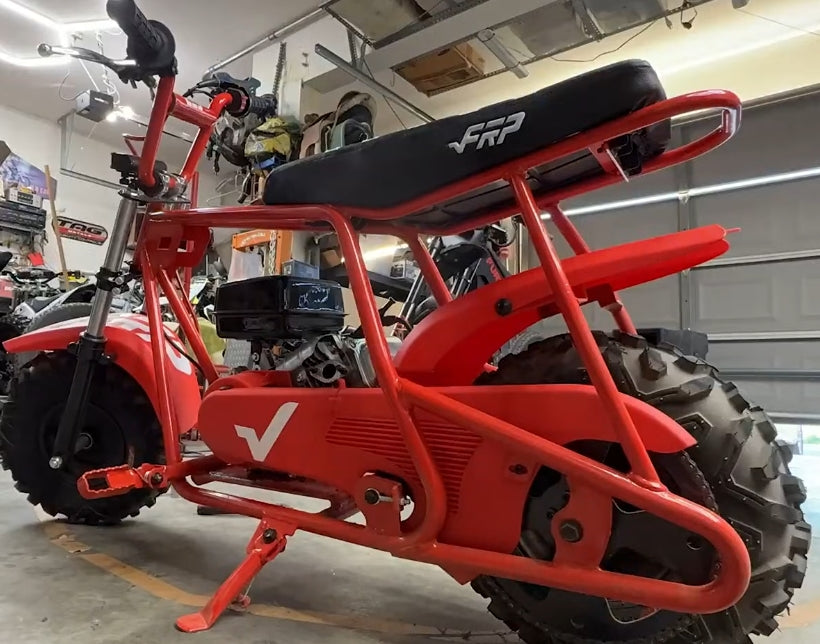
A gas mini bike uses a 4-stroke combustion engine (typically 40 cc–212 cc) with a centrifugal or torque-converter clutch. The rider platform is upright, with smaller wheel diameter (10"–12.5") than a full pit bike but larger than a pocket bike. Gas mini bikes run on regular 87 octane gasoline and can ride continuously as long as there's fuel in the tank — no charge cycles, no battery degradation.
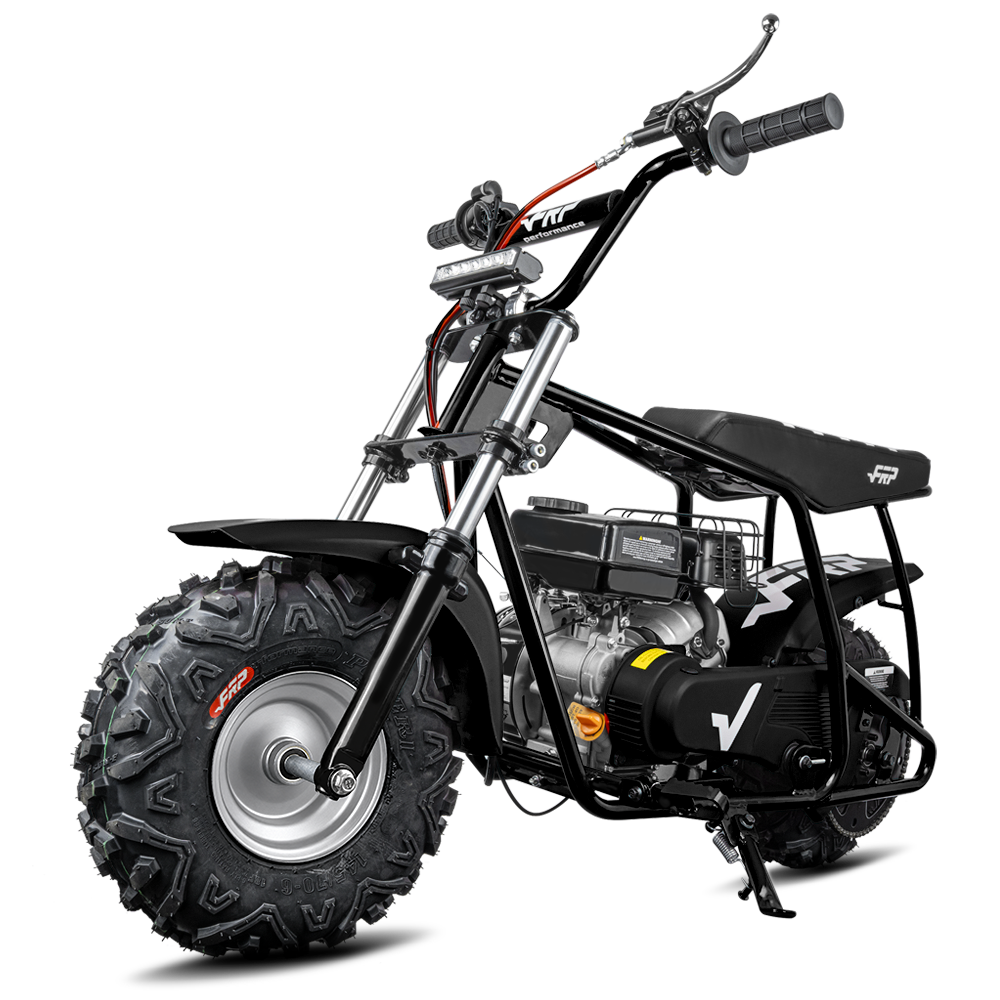
The FRP GMB100 represents the adult gas mini bike standard: 99cc, 220 lb weight limit, 24–28 mph, disc brake, $379.
Head-to-Head: Electric Pit Bike vs Gas Mini Bike
| Category | Electric Pit Bike | Gas Mini Bike (FRP GMB100) |
|---|---|---|
| Price (entry adult) | $1,200–$2,500 | $379 (GMB100) · $499 (GMB100P) |
| Top speed | 25–50+ mph depending on model | 24–28 mph stock · 35–45 mph (212cc) |
| Torque delivery | Instant, linear — strong from rest | Power band builds with RPM |
| Ride duration | 20–90 min per charge depending on pack size | Unlimited — refuel in 30 seconds |
| Noise level | Very quiet — motor whine only | Moderate — 99cc 4-stroke is surprisingly quiet vs 2-strokes |
| Maintenance | Low — no oil, no carb, no fuel system | Oil change every 20–25 hrs, chain tension (see the full maintenance schedule) |
| Repairability | Moderate — battery/motor repairs require specialized tools | High — centrifugal clutch, engine parts widely available |
| Operating cost | ~$0.02/ride in electricity | ~$0.80–$1.20/hour in fuel |
| Cold weather performance | Battery capacity drops 20–40% below 40°F | Not affected; choke adjustment for cold starts |
| Weight limit | 180–265 lb depending on model | 220 lb (GMB100) · higher with 212cc builds |
| Legal status | Off-road only (no VIN/DOT in most cases) | Off-road only, EPA-certified |
| Long-term battery | Capacity degrades ~20% over 3–5 years | N/A |
Where Electric Genuinely Wins
Noise
This is electric's clearest advantage. An electric pit bike produces a light motor whine at speed — nothing that will bother neighbors, disturb wildlife, or violate HOA quiet hours. If you live in a suburban neighborhood and want to ride in your backyard without generating complaints, electric removes that friction entirely.
To be fair: a 99cc 4-stroke gas engine is much quieter than most people assume. It doesn't sound like a lawnmower or a two-stroke at full throttle. But it is audible at a distance, and it has an exhaust note that some riding environments won't tolerate. Electric simply has no equivalent concern.
Low-RPM Torque
Electric motors produce peak torque at zero RPM. The acceleration from rest on a performance electric pit bike is more immediate and linear than a combustion engine, which has to build through its power band. For technical slow-speed maneuvers, this matters. For general riding at the speeds both platforms operate, it's less significant.
Maintenance Simplicity
No oil changes, no carburetor, no fuel system, no air filter. The electric drivetrain requires essentially no periodic service — unlike gas bikes, where carburetor cleaning is routine (see the carburetor maintenance guide)—scheduled maintenance in normal use. For buyers who don't want to wrench on their bike or learn engine maintenance, this is a real advantage.
Where Gas Wins
Price
A reliable adult electric pit bike starts at $1,200 and can run $2,500+ for a quality motor and battery system. The FRP GMB100 is $379. That's a $800–$2,000+ difference for bikes that largely serve the same casual riding use case.
You'd have to ride the electric bike for several years to recover the price premium in fuel savings. At $0.80–$1.20 per hour in fuel for a gas mini bike, and assuming 4 hours of riding per month, you're spending ~$40–$58/year on fuel. The price gap between a quality electric and a GMB100 would take 15–50 years to amortize in fuel savings.
Ride Duration
A 20–40 minute ride limit (typical for entry-level electric bikes at active riding pace) is a real constraint. Gas bikes refuel in 30 seconds and continue indefinitely. For family riding sessions that extend to 90 minutes or more, or for situations where you're riding in a remote location without power available, gas is the practical choice by a wide margin.
Cold Weather
Lithium batteries lose significant capacity in cold temperatures — typically 20–40% below 40°F, sometimes more at freezing temperatures. If you ride in fall, winter, or early spring in northern states, a 40-minute range battery may become a 25-minute battery. Gas engines are unaffected by cold weather (with normal choke adjustment).
Repairability
Centrifugal clutch and 99cc engine parts are available from dozens of suppliers. A blown gasket, worn clutch pad, or carb rebuild on a gas mini bike costs $20–$80 in parts and can be done in a driveway. Electric motor or battery failures require sending the unit to a service center, ordering proprietary parts, or — if the brand goes out of business — potentially having an unrepairable bike.
The Real Question: What Is "Electric Pit Bike" Actually Solving for You?
When buyers search for "electric pit bike," they're often motivated by one of these:
- Noise concerns — If this is your primary concern, a 99cc 4-stroke gas mini bike is much quieter than you might expect. Listen to a video before assuming gas is too loud for your situation.
- Fuel cost/convenience — Electric wins here, but the price premium takes years to offset in fuel savings at the riding frequencies most people maintain.
- Environmental preference — If minimizing fuel consumption matters to you, electric is the right call regardless of economics.
- Newer/tech-forward preference — Reasonable, and the electric bikes have improved significantly. But verify the range is sufficient for how you actually ride before buying at $1,500+.
What to Buy in 2026 Based on Your Situation
| Situation | Recommendation |
|---|---|
| Budget under $600 | Gas mini bike — no viable electric at this price |
| Budget $600–$1,200 | Gas mini bike — electric options here are generally underpowered or low-quality |
| Budget $1,200+ | Evaluate both — quality electric pit bikes start here |
| Riding sessions under 30 min | Either works; electric's range is sufficient |
| Riding sessions 45+ min | Gas — electric range is a real constraint |
| Cold climate (below 40°F regularly) | Gas — battery performance degrades significantly |
| Noise-sensitive environment (neighbors, HOA) | Electric — this is where it clearly wins |
| Remote location, no charging | Gas — carry a fuel can, not a generator |
| Riding with kids on gas bikes | Gas — easier to refuel and match pace together |
The Gas Mini Bike Starting Point — $379

FRP GMB100 — Gas, 99cc, $379
220 lb limit · 24–28 mph · Disc brake
Unlimited ride time, no charge cycles, EPA-certified. The price-to-value baseline for adult mini bike riding.
View GMB100 →
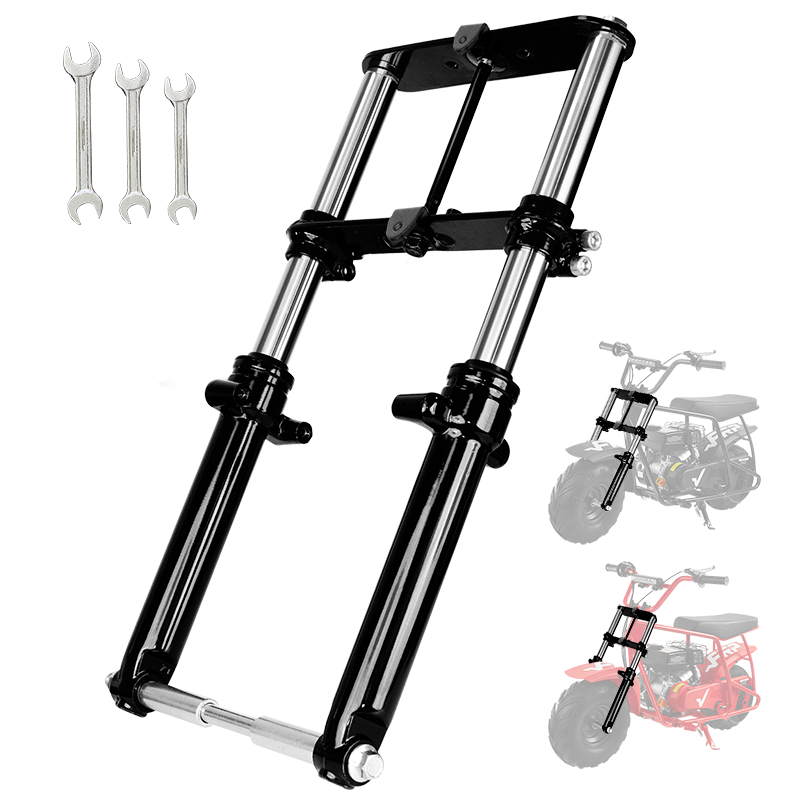
FRP GMB100P — Gas + Suspension, $499
99cc + hydraulic front fork
Adds front suspension for rougher terrain. Still $700+ less than entry-level quality electric options.
View GMB100P →Frequently Asked Questions
Are electric pit bikes worth it?
For buyers with a $1,200+ budget who value quiet operation and low maintenance, quality electric pit bikes are genuinely worth considering in 2026. For buyers under $800 looking at electric options, the current market doesn't offer competitive performance versus gas at that price — the value isn't there yet.
How long does an electric pit bike battery last?
Ride time: 20–90 minutes per charge, depending on battery capacity and riding intensity. Battery lifespan: most lithium packs maintain 80% capacity for 400–600 charge cycles; after 3–5 years of regular use, capacity begins degrading measurably. Replacement packs for name-brand electric bikes cost $300–$800.
Is a gas mini bike quieter than a lawnmower?
Yes — a 99cc 4-stroke engine like the GMB100 is measurably quieter than a typical lawnmower at operating RPM. The exhaust note is different, but the volume is comparable to a running lawnmower at idle, not at full throttle. Two-stroke engines are much louder; 4-stroke mini bikes are significantly more neighborhood-tolerable.
What is the fastest electric pit bike?
Performance electric pit bikes from brands like Stark Varg and KTM Freeride E-XC reach 50+ mph. These are $8,000–$12,000+ bikes in a different category than backyard riding. Entry-level adult electric pit bikes ($1,200–$2,000) typically top out at 30–45 mph depending on motor output and gearing.
Can I convert a gas mini bike to electric?
Conversion kits exist but the economics rarely make sense. A quality brushless motor, controller, battery, and throttle assembly costs $400–$800 for a conversion that still results in a modified gas bike frame with compromised weight distribution. Buying a purpose-built electric from the start is a better outcome if electric is your goal.
What is the best gas mini bike for adults in 2026?
For the under-$500 category, the FRP GMB100 is the consistent recommendation for adult riders — 220 lb weight limit, disc brake, EPA certification, and a parts ecosystem that makes maintenance straightforward. See the complete mini bike weight limit guide for how different bikes perform for heavier riders. If you're weighing gas against electric more broadly across the mini bike category — not just pit bikes — see our gas vs electric mini bike breakdown, based on real owner review data.