
TL;DR
Compare all sizes: mini bike top speed by engine size — 40cc to 212cc speed chart.
- A stock 212cc mini bike goes 35–40 mph on flat ground — the governor limits it, not the engine ceiling.
- Remove the governor and you're looking at 45–55 mph, depending on gearing and rider weight.
- Every 20 lbs of additional rider weight costs roughly 1–2 mph at the top end.
- Stock drum brakes are adequate to 40 mph. Going faster means upgrading to hydraulic brakes first.
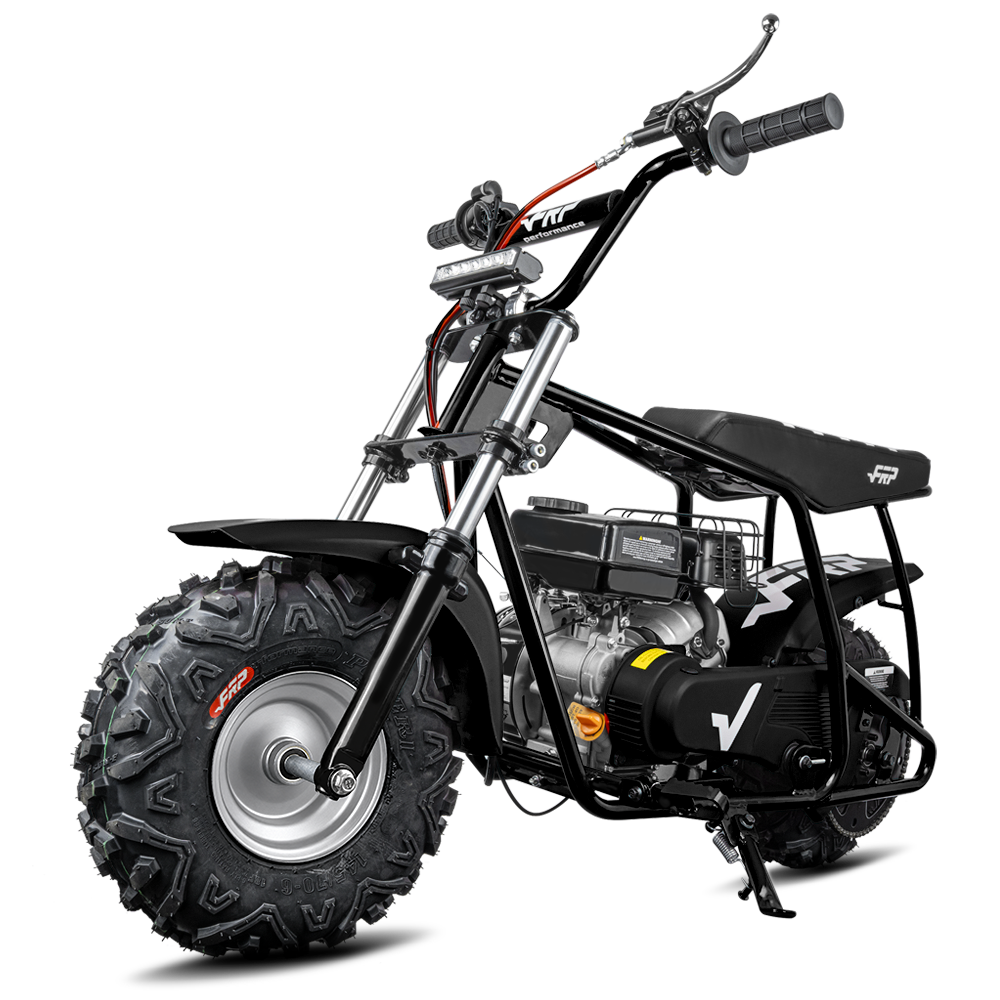
- The FRP GMB100 Frame accepts 99cc–212cc engines — the cleanest chassis for a 212cc build.
Most people searching this already know they want more speed. The real question is whether 212cc actually delivers it — or whether the stock setup disappoints the way a lot of listings imply it will.
Here's the direct answer: 35–40 mph on flat pavement, governor in, average adult rider. That's real. What you do with it from there depends on what you're building.
What the Governor Is Actually Doing to Your Speed
A 212cc Predator and most of its clones ship with a governor that caps the engine at roughly 3,600 RPM. The engine can physically rev to around 5,500 RPM before the stock valves float — that gap is where the missing speed lives.
At 3,600 RPM, a stock 212cc produces about 6.5 HP and 8.1 ft-lb of torque at 2,500 RPM. That pushes a 200 lb rider to 35–38 mph on flat ground. When the governor is removed and the engine can rev to 5,000–5,500 RPM, the same engine will push 45–55 mph, depending on your sprocket setup.
The governor is not a design flaw — it extends engine life and keeps the stock drivetrain from getting destroyed. It's also the reason "212cc top speed" searches return answers from 25 mph to 55 mph. They're all talking about different configurations of the same engine.
Stock 212cc Speed: What You Actually Get
| Setup | Top Speed | Notes |
|---|---|---|
| Stock 212cc, governor in, flat ground, 150 lb rider | 38–40 mph | Best-case stock |
| Stock 212cc, governor in, flat ground, 200 lb rider | 35–37 mph | Typical adult |
| Stock 212cc, governor in, uphill grade | 25–30 mph | Torque limited on grade |
| 212cc, governor removed, stock gearing | 45–50 mph | Upgrade brakes before this |
| 212cc, governor removed, performance gearing | 50–55 mph | Racing territory |
For most private-property adult riders doing backyard laps or light trail riding, 35–40 mph is the number to plan around. That's genuinely fast on a machine that sits 12 inches off the ground.
Gearing Changes the Number More Than Most Builders Expect
The engine produces the torque. The sprocket ratio determines what that torque translates to in top speed. On a standard mini bike setup:
- Fewer teeth on the rear sprocket = higher top speed, less low-end pull
- More teeth on the rear sprocket = stronger acceleration off the line, lower top speed
Swapping a 12-tooth rear sprocket to a 10-tooth on a stock-governor 212cc setup adds 4–6 mph at the top end. Riders who've done both setups consistently note that a correctly geared 212cc on a torque converter out-accelerates a poorly geared degoverned setup — gearing matters more than most first-time builders realize.
Before touching anything: decide on your use case. Backyard acceleration (keep the bigger sprocket, enjoy the pull) is a different setup than top speed (go smaller, accept the slower launch). You can't fully optimize for both on one sprocket.
99cc vs. 212cc: Is the Speed Difference Worth It?
The FRP GMB100 runs a 99cc engine. Stock top speed: 28 mph. That's not a slow number for backyard riding, trail loops, or a first gas mini bike. For riders under 150 lbs and most backyard setups, 28 mph is the right ceiling — manageable, fun, and within range of what stock brakes handle confidently.
A 212cc build on the GMB100 Frame gives you 35–40 mph stock, or 45+ mph with brake upgrades and gearing work. The jump from 99cc to 212cc isn't only a speed number. The torque profile changes: the 212cc pulls harder coming out of corners and responds differently to small throttle inputs. Most riders who've tried both describe it as "a completely different machine" rather than "faster version of the same thing."
Which FRP Setup Matches Your Speed Goal?

FRP GMB100 — 99cc
Top speed: 28 mph stock
Weight limit: 220 lbs
Backyard, flat trails, first adult gas mini bike
View GMB100 →
GMB100 Frame — Build Your 212cc
Engine-ready: 99cc–212cc
Fits: Predator 212, Honda GX200 clones
Adults who want 35–45+ mph performance
If you are still picking the donor bike rather than the engine, the frame matters more than the engine you bolt on later. Worth checking which of our mini bike models are built to take a 212 swap before you buy the base bike — retrofitting the wrong frame costs more than starting on the right one.
View Frame →Building a 212cc on the GMB100 Frame
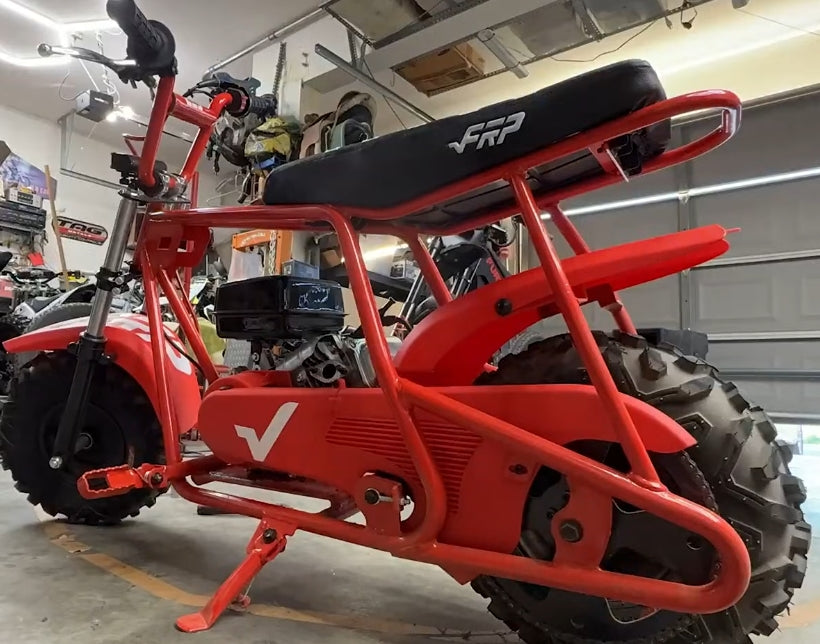
The GMB100 Frame is designed for exactly this kind of build. It ships without an engine, accepts 99cc through 212cc horizontal-shaft engines, and uses reinforced welded-steel geometry — not the pressed stamped steel found in most entry-level alternatives. A typical 212cc build:
- GMB100 Frame ($319.99)
- Predator 212cc engine — $99–$159 at Harbor Freight or equivalent
- Torque converter or centrifugal clutch (torque converter gives better low-end pull for most uses)
- Chain and sprocket matched to your speed goal
- Hydraulic brake upgrade if you plan to run consistently above 40 mph
Total build cost typically lands $550–$750 depending on parts sourced. Most failures on budget 212cc setups come from frame flex under load — not the engine. The GMB100 Frame addresses that directly.
One detail that catches new builders: engine mounting bolt pattern. The GMB100 Frame is spec'd for standard horizontal-shaft engines. Confirm your engine's bolt pattern against the frame spec before ordering. FRP's 365-day support line can verify compatibility if you're sourcing an engine from a third party.
What the Ride Actually Feels Like at 35 mph
Thirty-five miles per hour on a mini bike feels fast. The frame sits low — you're a foot off the ground — and there's nothing around you. The Predator 212 has a lower, deeper exhaust note than a 99cc; you feel the torque difference in the first 20 feet before you check the speedometer. Most riders who move from a stock GMB100 to a 212cc frame build describe the torque pull out of corners as the bigger surprise — not the top speed number itself.
Plan for a few laps to calibrate before you open it up.
For a full engine-size comparison — 40cc through 212cc race build — see the mini bike speed chart by engine size.
Torque Converter vs Centrifugal Clutch: Which Setup Works Best for 212cc?
The transmission choice on a 212cc build has more impact on the riding experience than most first-time builders expect. Two options dominate:
Torque converter (TAV): A variable-ratio drive that automatically adjusts the gear ratio as RPM changes. At low RPM (launch), it holds a lower ratio for strong pull off the line. As RPM rises toward the power band, the ratio shifts higher for top speed. For 212cc adult riding — trail use, variable terrain, frequent stops — a torque converter gives better low-end torque, less stalling, and a noticeably smoother power delivery. Cost: $60–$100. This is the recommended setup for most builders.
Centrifugal clutch: A simpler, cheaper ($25–40) engagement system that locks in at a fixed RPM. Works well for flat terrain and consistent-speed riding where you're not stopping and starting frequently. Less maintenance than a torque converter. On a 212cc build running 40+ mph on flat ground, a centrifugal clutch is perfectly adequate. For hilly terrain or trail riding with lots of throttle variation, the torque converter pulls ahead significantly.
Builder consensus from the GMB100 community: for first-time 212cc builds on the GMB100 Frame, start with the torque converter. You can always simplify later — it's harder to go back and add low-end pull you didn't know you were missing.
Gearing Math: How Sprocket Ratio Translates to Real MPH
Top speed on a 212cc build is not just engine output — it's the ratio between your engine sprocket and rear sprocket. The formula: (Engine RPM ÷ Gear Ratio) × Wheel Circumference. In practice, here's what common setups deliver at a degoverned 212cc running ~5,000 RPM:
| Setup | Drive / Rear Sprocket | Approx. Top Speed | Character |
|---|---|---|---|
| Stock-ish | 10T / 60T | 35–40 mph | Strong pull, moderate top speed |
| Performance | 12T / 60T | 42–48 mph | Balanced — most common build |
| Top speed | 12T / 54T | 48–55 mph | Slower launch, higher ceiling |
| Race build | 13T / 50T + cam/carb | 55–65 mph | Racing territory — upgrade brakes first |
Every tooth you remove from the rear sprocket (or add to the drive sprocket) shifts the ratio toward top speed. Every tooth you add to the rear (or remove from drive) shifts toward acceleration. You cannot optimize fully for both at one sprocket setting — choose your use case before ordering parts.
Frequently Asked Questions
How fast does a 212cc mini bike go with the governor?
35–40 mph on flat ground with an average adult rider. The governor caps the engine at roughly 3,600 RPM. A lighter rider (under 150 lbs) may see 38–40 mph; a heavier rider (200+ lbs) will typically be closer to 33–36 mph on the same setup.
How fast does a 212cc mini bike go without the governor?
45–55 mph depending on gearing, rider weight, and terrain. Remove the governor only after upgrading to hydraulic brakes — stock drum brakes are not designed for sustained use above 40 mph.
Is a 212cc faster than a 196cc mini bike?
Not significantly in stock form. A stock 196cc typically hits 30–35 mph; a stock 212cc hits 35–40 mph. The gap narrows with identical gearing. The 212cc has a slight torque advantage and more headroom for modifications.
Can a 212cc mini bike hit 50 mph?
Yes, but not stock. Reaching 50 mph reliably requires removing the governor, optimizing gearing for top speed, and upgrading brakes. Some fully built 212cc setups push past 55 mph with additional performance parts.
Does rider weight affect 212cc top speed?
Yes. Roughly 1–2 mph per 20 lbs of additional rider weight at stock governor speeds. A 150 lb rider sees the top of the stock range (38–40 mph); a 220 lb rider will be closer to 33–35 mph on the same setup.
What brakes do I need for a 212cc mini bike above 40 mph?
Hydraulic disc brakes. Stock drum brakes are designed for the speed range the bike ships in. If you're removing the governor and targeting 45+ mph, upgrade the brakes before chasing that speed. FRP's hydraulic brake kit is compatible with the GMB100 Frame chassis.
What to Read Next
- → How Do I Mount a 212 Engine on a GMB100 Mini Bike? — full frame-to-throttle build sequence for the 212cc swap.
- → Is a 212 Swap Cheaper Than Modding the Stock GMB100 Motor? — real cost breakdown before you commit to the build.
- → How Fast Does a 212cc Mini Bike Go? (Updated Guide) — expanded speed data with gearing tables and rider weight variables.
- → Does a 212 Swap Require Better Brakes on a Mini Bike? — stopping power check before you ride the swapped build.