Your cart is empty
return to shopFor the FRP GMB100's 99cc engine—and any 212cc or 224cc swap running on the same frame—the correct oil change interval is every 10 to 20 hours of riding time, not by odometer, and not by the 5-hour break-in rule still printed in many generic manuals. Air-cooled engines under real riding conditions burn through oil faster than lab specs assume. This guide covers when to change it, what to use, how to read the warning signs, and what to do when your pull starter starts giving you trouble.
Quick Clarification: 4-Stroke Oil Is Not 2-Stroke Oil Mix
FRP GMB100-series mini bikes use 4-stroke engine oil in a separate oil reservoir. Do not mix 2-stroke oil into the gasoline for these 4-stroke models.
If you are working on a separate 2-stroke engine that requires premix, use the dedicated 2-stroke oil mix calculator and ratio chart. If you own an FRP GMB100, MB40, Sahara 40, or Ogemaw 40, follow the 4-stroke oil and maintenance guidance for that model instead.

Why Hours, Not Miles, Is the Right Metric?
A water-cooled car engine buffers heat through a closed coolant loop. Your mini bike doesn't have that. The 99cc OHV engine on the GMB100 is air-cooled, meaning every variation in ambient temperature, load, and terrain translates directly into oil temperature.
At 28 mph on flat packed dirt, the engine runs relatively cool. Running the same bike through loose sand in Arizona at 95°F, or up a steep hill with a 200-lb rider, is a completely different thermal load—even if the odometer reads the same distance.
Tracking hours gives you a real picture of engine stress. A 30-minute trail session at full throttle is not the same as a 30-minute cruise on flat pavement. The oil doesn't know the difference in miles—but it absolutely feels the difference in heat cycles.
Our baseline: Change oil every 10 hours under high-intensity conditions (aggressive trail riding, high ambient temps above 90°F, heavier riders near the 220 lb limit). Under relaxed conditions—backyard loops, light terrain, cooler weather—20 hours is a reasonable outer limit.
If you don't track hours, here's a practical rule: change the oil at the start of every riding season, and again mid-season if you're putting in regular weekend sessions.

What Black Oil Is Actually Telling You
One of the most common questions we hear from riders in hot-climate states like Florida, Texas, and Arizona: "My oil turns black after only a few hours—is something wrong?"
Not necessarily. Dark oil is the normal result of an air-cooled engine managing thermal load. As oil circulates through a hot engine, it oxidizes, picks up combustion byproducts, and suspends microscopic metal wear particles from normal break-in and operation. The black color is the oil doing its job—absorbing contaminants so they don't sit on your cylinder walls.
What you're looking for is the difference between dark oil and degraded oil:
- Dark but fluid: Normal. Change it on schedule.
- Dark and gritty: Change it now. You're past the safe window.
- Dark and milky or foamy: Stop riding. This indicates water contamination—check for a head gasket issue.
- Low on the dipstick: Air-cooled engines can consume oil, especially in high-heat conditions. Check the level before every ride.
The Right Oil for Your GMB100 and 212cc Engine
For the FRP GMB100 series, use SAE 15W-40 four-stroke engine oil for most climates. The current GMB100P manual lists approximately 0.35 L capacity, but the dipstick is the final guide for the fill level.
If gasoline-rated 15W-40 is difficult to find, FRP Moto service guidance allows 10W-30 four-stroke oil as an alternative. A Predator 212 or 224 engine is a separate engine platform; follow that engine manufacturer's viscosity chart instead of assuming the FRP 99cc specification applies.
A few points worth noting:
- The GMB100 takes standard four-stroke motor oil. No mixing required—this is a 4-stroke OHV engine.
- Recommended fuel is #87 regular gasoline. The bike ships with an empty tank.
- Always check the oil level on a level surface with the engine cool, before the first ride of the day.
GMB100 Frame Geometry and What It Means for Maintenance Access
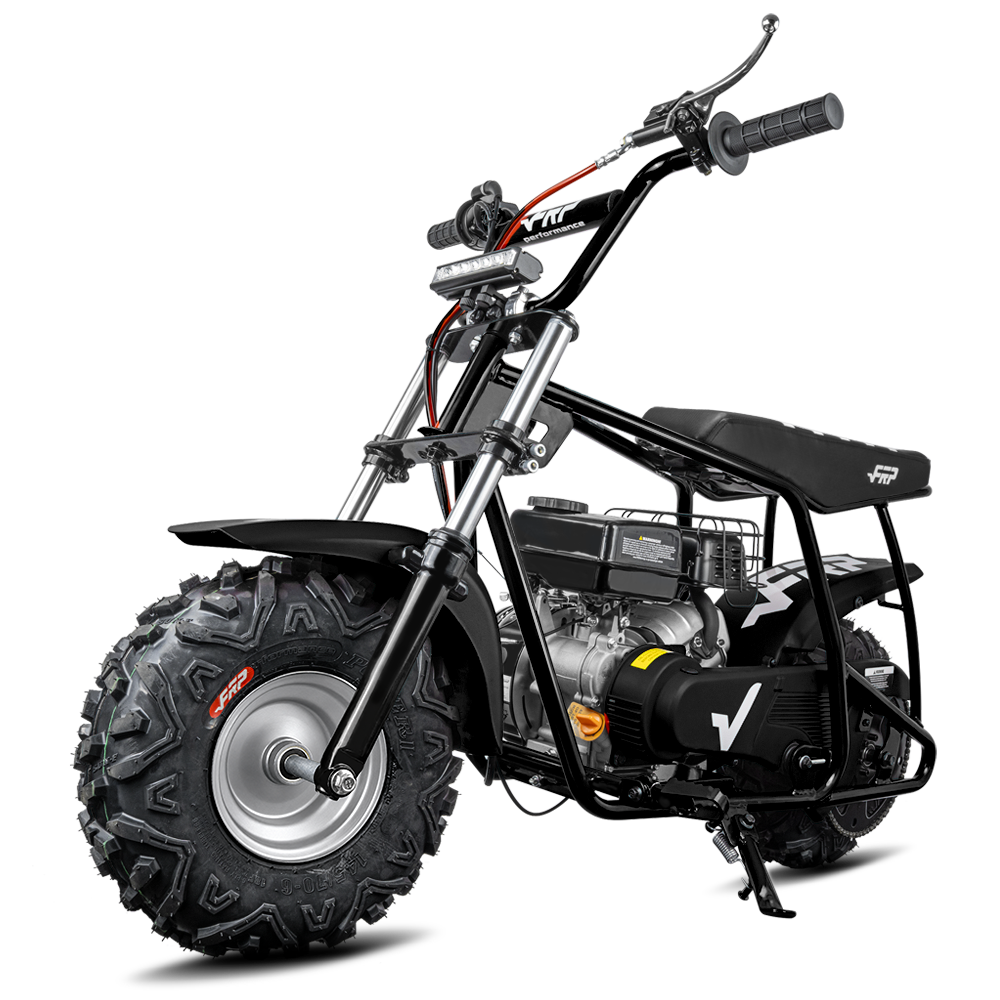
The GMB100 runs a 900mm wheelbase on a fully equipped tube steel frame—a geometry spec that reflects a deliberate stability decision for riders up to 220 lbs. The longer wheelbase tracks straighter at speed and is more forgiving on uneven terrain compared to shorter-wheelbase youth bikes.
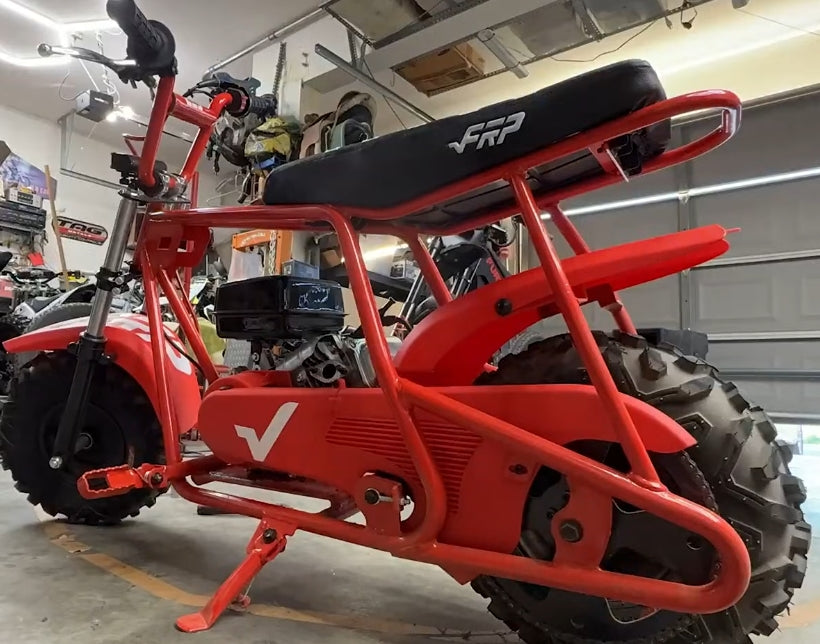
For maintenance, the practical implication is access. The drain bolt on the 99cc OHV engine sits low and toward the rear of the engine case. On flat ground with the kickstand down, you'll want a low-profile drain pan. A 17mm socket handles the drain plug on most of these engines.
The 145/70-6 pneumatic tires deserve attention, too. Recommended operating pressure is 10–15 PSI. At the lower end, you get better traction on loose dirt. At the higher end, rolling resistance drops for pavement use. Check pressure monthly—these tires hold air well, but small drops over time affect both handling and wear patterns.
The Pull Starter Problem: What's Happening and What We're Doing About It
We want to address this directly, because we hear it regularly: the pull starter on high-compression 212cc and 224cc engines is a known weak point.
The physics are straightforward. A high-compression engine requires more force to turn over. That force goes through the recoil mechanism—the cord, the pawl, the spring, and on many stock engines, a plastic flywheel housing that wasn't designed with this compression ratio in mind. A snapped cord or seized pawl after 2–3 hours of use isn't a fluke; it's a predictable failure mode.
Our current recommendation for riders running 212cc/224cc swaps:
- Inspect the pull cord before every riding session for fraying near the handle and at the entry point to the housing.
- Replace the cord at the first sign of wear—don't wait for it to snap mid-ride.
- Avoid "ripping" the starter—a slow, firm, full pull puts less shock load on the mechanism than a fast yank.
We're also not standing still on this. We are actively developing a reinforced aluminum flywheel assembly to replace the stock plastic components on these high-compression builds. The aluminum unit provides significantly better heat tolerance and impact resistance. We'll publish specs and compatibility details when the part is ready for release.
Diagnosing the Full-Throttle Bog
If your GMB100 or 212cc-swapped bike runs fine at partial throttle but stutters or loses power at wide-open throttle (WOT), the most common causes are:
1. Fuel delivery restriction: A partially clogged main jet limits fuel flow at high demand. Remove the carburetor bowl and inspect the main jet. Clean with carburetor cleaner and compressed air. Do not enlarge the jet orifice.
2. Vibrating idle jet Engine vibration can gradually loosen the idle jet, causing an erratic air-fuel mix at transition points. Remove the jet, inspect the seat surface, and reinstall snugly (finger-tight plus a quarter turn—no more).
3. Air filter restriction A clogged foam air filter is often overlooked. Remove it, wash with mild soap, dry completely, and re-oil lightly with foam filter oil before reinstalling.
4. Throttle cable binding: Check that the cable routes freely through the housing with no sharp bends. A binding cable prevents the slide from reaching full lift.
Run through these four steps in order before assuming the carburetor needs replacement. In most cases, a clean and re-inspection resolves the WOT bog entirely.
Full Maintenance Schedule: GMB100 and 212cc Engines
| Component | Interval | Action |
|---|---|---|
| Engine Oil | 10–20 riding hours | Drain and replace (FRP GMB100 series: 15W-40; other engines: follow the engine manual) |
| Oil Level | Before every ride | Check the dipstick on a level surface, cold engine |
| Air Filter | Monthly or 20 hours | Inspect, clean, or replace |
| Chain Tension | Before every ride | 1/2 inch of play at mid-span |
| Chain Lubrication | Every 5 hours | Light coat of chain lube |
| Pull Starter Cord | Every 10 hours | Inspect for fraying at the handle and housing entry |
| Tire Pressure | Monthly | 10–15 PSI |
| Fuel System | If stored 30+ days | Drain or treat with fuel stabilizer |
| Carburetor Bowl | Seasonally | Inspect and clean the main jet |
| Rear Disc Brake | Monthly | Check pad wear and cable/lever feel |
Print this table and keep it in your tool kit. The riders who avoid major repairs are almost always the ones doing small checks consistently.
Service load varies by platform more than by brand — a stock 99cc four-stroke and a 212cc build do not carry the same interval. If you are choosing a bike partly on how much upkeep you want to take on, the FRP mini bike lineup is a reasonable place to compare engine type before buying.
FAQ
How often should I change the oil on a 99cc mini bike? Every 10–20 riding hours, depending on conditions. Use the 10-hour end for hot weather, aggressive terrain, or riders near the 220 lb weight limit. Use the 20-hour end for light recreational riding in mild weather. Always change oil before storing the bike for the season.
What oil does the FRP GMB100 take? SAE 15W-40 four-stroke engine oil is the primary recommendation for most climates. Approximate capacity is 0.35 L, but fill by the dipstick. If gasoline-rated 15W-40 is difficult to find, 10W-30 four-stroke oil is an acceptable alternative under FRP Moto service guidance. Never use two-stroke premix oil.
Why does my mini bike's oil turn black so quickly? Black oil is normal in air-cooled engines. It means the oil is doing its job—absorbing combustion byproducts and wear particles. The concern isn't color; it's consistency and level. Gritty, milky, or foamy oil signals a problem. Dark but fluid oil just needs to be changed on schedule.
How do I fix a pull starter on a 212cc mini bike? Inspect the cord for fraying at the handle and housing entry. Replace at the first sign of wear. A slow, firm pull puts less stress on the mechanism than a fast yank. For 212cc/224cc engines specifically, the stock plastic flywheel housing is a weak point under high compression—plan for more frequent inspection than you would on a stock 99cc.
What fuel does the FRP GMB100 use? Regular #87 gasoline. The bike ships with an empty tank, so pick up fuel before your first ride. If storing the bike for more than 30 days, drain the tank or add fuel stabilizer to prevent carburetor gumming.
The Bottom Line
Consistent maintenance on a mini bike is not complicated—it's just a matter of knowing the right intervals and actually following them. The 10–20 hour oil change rule, regular chain checks, and a quick pull starter inspection before each session will keep your GMB100 running reliably across hundreds of hours of riding.
The FRP GMB100 99cc Mini Bike ships 85% pre-assembled, arrives ready to ride in under an hour, and is backed by a 75-day return window—the longest in this category.